
AI-driven portfolio rebalancing uses advanced algorithms to keep your investments aligned with your goals. It analyzes market trends, tax implications, and risks in real time, automating the process and eliminating the need for manual adjustments. This approach ensures consistent risk management, cost savings, and better long-term performance.
Key highlights:
- Real-time adjustments: Monitors portfolios 24/7 for precise rebalancing.
- Tax efficiency: Avoids costly wash sales and optimizes asset location.
- Cost savings: Reduces trading fees and eliminates advisor costs, potentially saving over $1 million in fees over 30 years.
- Risk management: Identifies hidden risks and ensures diversification across stocks and bonds.
- Behavioral benefits: Removes emotional biases like loss aversion and herd behavior.
Platforms like Mezzi make these tools accessible, offering features like a unified financial dashboard, tax optimization, and advanced risk analysis. They provide actionable insights, helping investors make informed decisions and achieve better long-term growth.
AI rebalancing simplifies portfolio management, saving time and money while improving efficiency and returns.
How AI-Powered Rebalancing Works
Automation and Real-Time Adjustments
AI-powered rebalancing works tirelessly, monitoring your portfolio 24/7 instead of sticking to rigid schedules like quarterly or annual reviews. It analyzes vast amounts of market data - such as volatility trends, sector performance, and economic indicators - to make adjustments at the most opportune moments.
Unlike traditional methods that depend on human judgment and periodic evaluations, AI systems excel at spotting subtle market shifts and portfolio imbalances before they grow into bigger issues. This constant vigilance helps keep your portfolio aligned with its target allocation, no matter how the market fluctuates. For example, if growth stocks suddenly surge and throw off your asset mix, AI systems can promptly suggest adjustments to bring your portfolio back in line. The result? Your portfolio stays on track with its intended risk profile and long-term growth goals, without the delays that come with manual rebalancing.
This around-the-clock oversight doesn’t just provide precision - it also saves both time and money.
Cost and Time Savings
AI-driven rebalancing can significantly cut costs by timing trades strategically and minimizing unnecessary transactions. These systems evaluate factors like transaction fees, bid-ask spreads, and market liquidity to execute trades when costs are at their lowest. For investors, this can translate into saving hundreds or even thousands of dollars annually in trading fees.
The time savings are just as impactful. For self-directed investors, AI takes over the heavy lifting of analysis and decision-making. This means you can focus on broader financial planning while your portfolio benefits from professional-grade management. Over time, these efficiencies - optimal timing and reduced costs - compound, contributing to stronger long-term returns.
| Feature | Traditional Rebalancing | AI-Powered Rebalancing |
|---|---|---|
| Timing | Periodic (e.g., quarterly) | Continuous, real-time |
| Decision-Making | Human judgment | Algorithm-driven |
| Tax Consideration | Basic awareness | Advanced optimization |
| Cost | Higher transaction costs | Lower trading costs |
Tax Optimization and Risk Management
AI doesn’t just streamline processes - it also integrates advanced tax and risk strategies to safeguard your gains. Tax management, for instance, is a major strength. AI systems are adept at handling the complexities of tax implications during rebalancing, especially when it comes to avoiding wash sales across multiple accounts, which can eat into your after-tax returns. By automating these processes, AI reinforces existing strategies while introducing sophisticated tax optimization techniques.
Risk management is another area where AI shines. Using machine learning and AI-driven risk predictions, these systems continuously monitor portfolios for potential exposures. They can uncover hidden correlations and emerging risks, enabling swift action to protect your investments.
Take Mezzi’s platform as an example. Its wash sale prevention system operates seamlessly across all connected accounts, flagging potential violations and suggesting alternative trades. This ensures your portfolio maintains both its desired allocation and tax efficiency - something nearly impossible to achieve manually.
AI also acts as an early warning system, helping investors prepare for unfavorable market conditions. By modeling potential outcomes, it can recommend defensive strategies when needed. Additionally, it identifies unintended concentrations in specific sectors or asset classes, alerting you to risks that could compromise diversification.
Together, these advanced tax and risk management tools create a robust framework for protecting and growing your wealth. By removing emotional biases - like hesitation or regret - from rebalancing decisions, AI helps investors achieve better risk-adjusted returns and maintain consistent long-term growth.
Measuring AI-Driven Rebalancing Performance
Key Performance Metrics
To evaluate the effectiveness of AI-driven rebalancing, it's essential to focus on metrics that reflect both portfolio returns and operational efficiency. Annualized return is a fundamental measure, indicating how much a portfolio grows on average each year. However, for a more refined perspective, the Sharpe ratio comes into play. This metric assesses risk-adjusted returns, showing how much extra return is earned for the volatility endured. AI systems often maintain higher Sharpe ratios by ensuring consistent allocations and reducing timing-related errors.
Another vital metric is tax efficiency, which reveals how much of your gross returns remain after accounting for taxes. AI-driven systems excel here by timing trades strategically to reduce tax drag and by avoiding costly mistakes like wash sales. Comparing after-tax returns to pre-tax returns provides a clear picture of how well these strategies are working.
Additionally, tracking error measures how far a portfolio deviates from its target allocation, while the transaction cost ratio highlights the percentage of returns lost to trading fees.
Cost Savings and Long-Term Value
AI-driven rebalancing isn't just about performance - it also delivers meaningful financial savings. By eliminating traditional advisory fees while maintaining high-quality portfolio management, these platforms can significantly enhance long-term wealth. For instance, consider a $500,000 portfolio growing at 7% annually over 30 years. A 1% advisory fee could accumulate to over $1 million in costs. AI platforms remove these recurring fees, while also offering better tax strategies and more precise rebalancing.
The Mezzi platform exemplifies these cost-saving benefits.
Mezzi Platform Benefits Example
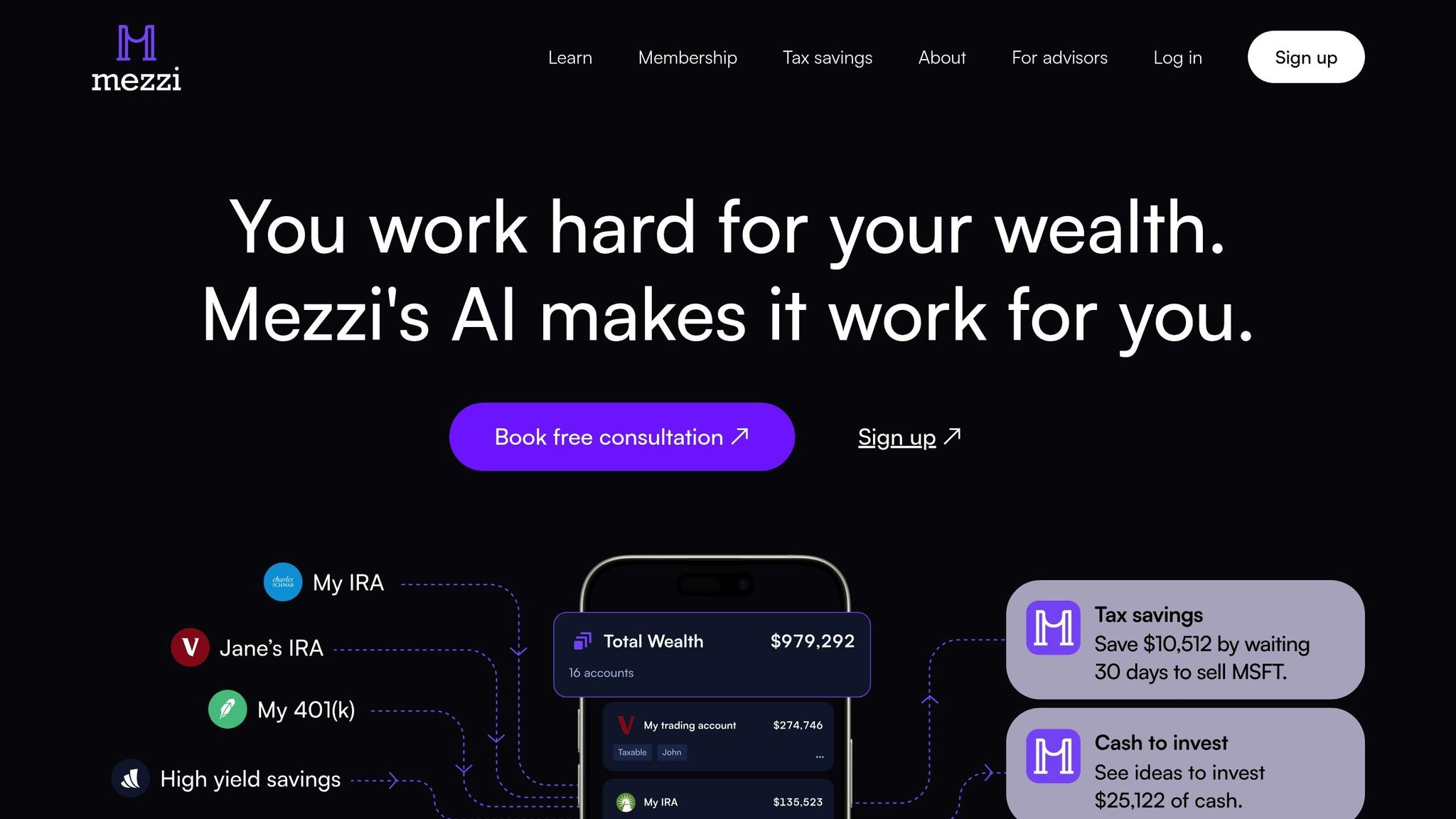
Mezzi demonstrates how AI-driven rebalancing can lead to tangible portfolio improvements. Its system actively prevents wash sale violations across all accounts, a common and costly issue. The X-Ray feature identifies hidden portfolio concentrations that might escape notice during manual reviews, ensuring a more balanced and diversified allocation.
Mezzi’s unified account view enables advanced analysis across multiple financial institutions. This functionality helps uncover tax-loss harvesting opportunities and optimizes asset location by placing tax-inefficient investments in tax-advantaged accounts, further reducing transaction costs. Additionally, Mezzi’s Financial Calculator uses real-time data to project long-term outcomes, providing personalized insights into how different rebalancing strategies and fee structures can influence wealth growth.
Studies back these advantages, showing that AI-driven rebalancing reduces emotional biases like regret aversion and loss aversion. This leads to more disciplined decision-making and, ultimately, higher long-term returns. Platforms like Mezzi enhance trust by offering transparent algorithms and ensuring users retain control over key decisions, supported by clear explanations of recommendations.
Behavioral Benefits of AI Rebalancing
Reducing Emotional Biases in Investing
Investing often stirs up emotions, and those emotions can lead to costly mistakes. For example, loss aversion might cause investors to hold onto losing positions for too long, hoping they'll bounce back. On the flip side, overconfidence can push people into excessive trading or poorly timed decisions. AI-driven rebalancing systems overcome behavioral biases by sticking to data-backed strategies, removing emotions from the equation entirely.
Another common trap is regret aversion, where fear of making the "wrong" move prevents effective rebalancing, often leading to over-concentration in certain assets. AI, however, operates without hesitation, executing trades based on target allocations regardless of past performance, even if that means selling high-performing assets.
Then there's confirmation bias - seeking out information that aligns with existing beliefs while ignoring contradictory data. AI doesn't fall into this trap. It processes market data objectively, using quantitative analysis to make allocation decisions rather than cherry-picking favorable details.
Herd behavior is another challenge, where investors follow the crowd, buying during market highs and selling during downturns. AI rebalancing systems stick to a consistent schedule, buying undervalued assets and selling overvalued ones. This disciplined approach not only avoids herd-driven mistakes but also helps investors build trust in AI's ability to manage portfolios effectively.
Building Trust in AI Systems
Trust is essential when it comes to AI-driven solutions, and it grows through transparency and clear communication. Successful platforms ensure investors understand the reasoning behind every recommendation, providing detailed explanations for suggested trades.
Combining AI insights with human oversight can also strengthen trust. This hybrid approach allows investors to maintain control while leveraging the analytical power of AI.
For many, trust develops gradually. A step-by-step adoption process - starting with analysis and moving toward full automation - helps investors ease into the technology. Over time, as they see consistent and accurate results, confidence in AI-driven adjustments grows.
Clear performance tracking is another key element. Regular updates and detailed metrics show investors the tangible benefits of AI-driven portfolio management, reinforcing their trust in the system.
Making Confident Investment Decisions
AI provides clarity that empowers investors to make decisive portfolio adjustments. With specific, data-driven recommendations, it eliminates the indecision that often stalls necessary changes.
One major advantage is real-time monitoring, which ensures investors are always in the loop. Unlike traditional rebalancing, which might occur quarterly or annually, AI keeps an eye on portfolios continuously, flagging significant drifts or opportunities as they arise.
Take Mezzi's X-Ray feature as an example. It uncovers hidden overlaps in portfolios - something manual analysis might miss. By clearly showing how holdings overlap across different accounts and funds, it helps investors make smarter allocation decisions.
AI also offers scenario analysis, allowing investors to explore how different strategies might play out under various market conditions. This ensures that any chosen approach aligns with their risk tolerance and long-term goals.
Tax impact analysis is another game-changer. By calculating the tax implications of proposed trades and showing the net benefits after taxes and fees, AI removes much of the anxiety around complex financial decisions.
Finally, a unified account view gives investors a complete picture of their finances across all accounts and institutions. This holistic perspective allows for more strategic rebalancing decisions, ensuring that adjustments support long-term growth rather than focusing narrowly on individual accounts.
Best Practices for AI-Driven Rebalancing Success
Setting Clear Investment Goals
Start by identifying your financial objectives - whether it’s saving for retirement, funding education, or building a $2 million portfolio. These goals serve as the foundation for your AI-driven rebalancing strategy, ensuring it aligns with your priorities.
It’s equally important to define your risk tolerance and investment timeline. For example, an aggressive strategy might suit a 30-year horizon, while a more conservative approach is better for shorter-term needs. Don’t forget to consider liquidity requirements, like having funds available for emergencies or major purchases. AI tools can factor these needs into their recommendations, helping you maintain adequate cash reserves while still aiming for growth. Mezzi’s features are designed to optimize your portfolio based on these personalized objectives.
Using Mezzi's Advanced Features
Once your goals are clear, Mezzi’s advanced tools simplify the rebalancing process. One standout feature is Mezzi’s X-Ray tool, which identifies hidden portfolio overlaps that you might miss manually. This helps you spot unintended overexposure to certain stocks across funds or accounts, enabling smarter allocation decisions.
Another key feature is Mezzi’s tax optimization system, which actively monitors for wash sales across accounts. By avoiding these tax pitfalls, you can reduce unnecessary costs and keep more of your returns.
For retirement planning, Mezzi’s Financial Calculator provides detailed projections by factoring in asset manager fees, annual contributions, and expected returns. This tool gives you a clear picture of your savings trajectory, helping you make informed adjustments. Additionally, Mezzi’s unified account view ensures your rebalancing decisions are aligned with your overall strategy.
Real-time prompts are another valuable feature. Mezzi monitors your portfolio and alerts you only when significant drifts or opportunities arise, so you can act quickly without being overwhelmed by unnecessary notifications.
Regularly Reviewing AI Insights
Even with advanced AI tools, regular reviews are crucial to ensure your strategy stays on track. Set aside time each month to evaluate the AI’s insights and confirm they align with your goals. This ongoing human oversight ensures that the suggestions remain relevant, especially if your financial situation or market conditions change.
These reviews also help counter emotional decision-making, which can derail long-term performance. By trusting data-driven recommendations, you can stay focused on achieving your objectives.
Pay attention to key performance indicators like risk-adjusted returns, cost savings from optimized trades, and tax efficiency improvements. These metrics reveal whether the AI-driven approach is delivering measurable benefits over time.
As your life evolves - whether through a promotion, a major purchase, or other significant events - update your goals and system settings to reflect your new circumstances. A hybrid approach, combining AI insights with periodic human reviews, often yields better outcomes. Research shows this blend of automation and oversight can improve behavioral discipline and enhance risk-adjusted returns. Regular reviews reinforce a disciplined rebalancing strategy, which is essential for long-term growth.
Amundi & MDOTM: Mass Portfolio Customization & Rebalancing With AI | Beyond The Noise Ep. 2
Conclusion: Long-Term Growth with AI-Driven Rebalancing
AI-driven rebalancing is changing the game for self-directed investors, offering a smarter, more efficient way to build long-term wealth. Research shows that investors using AI-based tools experience reduced stress, quicker decision-making, and fewer emotionally driven mistakes - all of which contribute to higher annualized returns. By removing much of the guesswork and emotional traps that often derail investment success, this technology paves the way for a more streamlined and confident approach to portfolio management.
Traditional rebalancing methods often come with drawbacks like higher transaction costs, poorly timed adjustments, and compounding human errors. In contrast, AI systems continuously monitor portfolios and apply customizable tax workflows, potentially saving investors thousands of dollars annually while improving overall efficiency.
Platforms like Mezzi demonstrate how AI is making sophisticated financial strategies accessible to everyday investors - strategies that were once reserved for those with access to costly advisors. These tools are part of a growing ecosystem designed to adapt in real time to individual financial circumstances, providing a tailored and responsive approach to investment management.
Experts across the financial industry agree: AI is revolutionizing portfolio management by delivering more precise, flexible, and cost-effective strategies. By minimizing human error and emotional biases, AI fosters consistent decision-making and enhances risk-adjusted returns over time. This consistency becomes even more critical as portfolios grow and market volatility tests investors' resolve. This is particularly true during periods of volatility clustering, where rapid price swings can lead to significant portfolio drift.
The potential savings are staggering. Eliminating advisory fees alone could save investors over Eliminating advisory fees alone could save investors over $1 million over 30 years million over 30 years, while still granting access to institutional-level portfolio management. When paired with the improved performance of systematic rebalancing, the result is a compounding effect that accelerates wealth accumulation.
To fully benefit from AI-driven rebalancing, it’s essential to combine automated insights with periodic human oversight. This balance ensures that strategies remain aligned with evolving financial goals. As AI adoption in portfolio management continues to expand, early adopters are well-positioned to reap the rewards of this transformative technology. The era of AI-driven rebalancing is here, offering a practical and powerful way for savvy investors to grow and protect their wealth in an ever-changing financial landscape.
FAQs
What makes AI-driven rebalancing more cost-effective and efficient than traditional portfolio management?
AI-driven rebalancing takes portfolio management to the next level by using real-time data and sophisticated algorithms to make automatic adjustments. Unlike traditional methods that depend on periodic reviews and manual updates, this approach ensures your portfolio is continuously fine-tuned, significantly cutting down on human error and saving valuable time.
This automation doesn't just streamline the process - it also trims management costs and boosts efficiency. By addressing imbalances quickly and maintaining ideal asset allocation, AI-driven rebalancing helps to smooth out portfolio volatility over time, offering stronger support for long-term growth compared to older, manual strategies.
How does AI-driven rebalancing improve after-tax returns through tax optimization?
AI-powered rebalancing improves after-tax returns by using sophisticated tax strategies, such as:
- Tax-loss harvesting: Selling underperforming assets to offset gains, which helps lower your taxable income.
- Asset location optimization: Placing investments in the right accounts - taxable or tax-advantaged - to reduce tax exposure.
- Real-time tax-aware adjustments: Continuously monitoring your portfolio to make tax-smart moves as market conditions shift.
Together, these approaches aim to boost your portfolio’s growth over time while keeping tax impacts to a minimum.
How does AI-driven rebalancing reduce emotional biases and improve investment decisions?
AI-powered rebalancing takes the emotions out of investing by relying on data and algorithms to make decisions. This eliminates the sway of fear, greed, or impulsive reactions, promoting a more logical and disciplined way to manage investments - especially in turbulent markets.
These tools can also spot hidden behavioral patterns and biases, offering actionable insights that guide investors toward more thoughtful, informed choices. The result? Fewer emotional mistakes and a stronger foundation for long-term portfolio growth.
Related Blog Posts
Table of Contents
Book Free Consultation
Walk through Mezzi with our team, review your current situation, and ask any questions you may have.