
AI tax-loss harvesting uses automation to identify and execute tax-saving opportunities by selling investments at a loss to offset taxable gains. Unlike manual methods, AI continuously monitors portfolios in real-time, ensuring compliance with IRS rules like wash sales and optimizing trade timing. This approach can reduce errors, save time, and potentially increase after-tax returns.
Key Takeaways:
- What It Does: AI automates tax-loss harvesting by analyzing portfolios 24/7 and identifying losses to offset gains.
- How It Works: Tracks investments, ensures compliance with IRS wash sale rules, and executes trades efficiently.
- Benefits: Reduces taxes, saves time, avoids errors, and improves portfolio management.
- Limitations: Relies on accurate data, may lack personal judgment, and depends on market conditions.
AI tax-loss harvesting is ideal for investors managing multiple accounts or those seeking to simplify complex tax strategies while maximizing savings.
How AI Tax-Loss Harvesting Works
Portfolio Monitoring and Loss Detection
AI systems work around the clock, analyzing your portfolio to uncover tax-loss opportunities. Unlike traditional manual reviews, which might happen monthly or quarterly, these algorithms operate in real time, constantly tracking price changes and recalculating potential tax benefits. By comparing the market value of each investment to its cost basis, they can quickly identify unrealized losses. This is particularly advantageous during volatile markets, where some assets may dip temporarily while others rise, creating ideal conditions for harvesting losses. On top of that, AI prioritizes losses that most effectively offset your gains, ensuring maximum tax savings. This continuous monitoring allows for precise alignment with tax regulations.
Following IRS Wash Sale Rules
AI plays a key role in helping investors avoid costly wash sale violations, which can disqualify tax deductions. The wash sale rule prohibits claiming a capital loss if you sell an asset at a loss and then repurchase the same or a "substantially identical" security within 30 days before or after the sale. AI systems track all transactions across your accounts and monitor the entire 61-day window (30 days before and after the sale) to ensure compliance. This is especially helpful if you manage multiple brokerage, retirement, or taxable accounts, where accidental repurchases could occur. The system also selects replacement investments that maintain your market exposure without triggering the wash sale rule. If a wash sale does happen, the disallowed loss is added to the cost basis of the replacement security, ensuring the tax benefit isn’t claimed prematurely. Additionally, AI documents these replacement choices, keeping your tax records organized and audit-ready.
Trade Timing and Execution
AI algorithms are designed to optimize trade timing and execution, balancing tax benefits with minimal trading costs. By simultaneously evaluating market conditions, transaction fees, portfolio balance, and tax implications, these systems pinpoint the best moments to execute trades. This precision can reduce trading costs by 0.1–0.3% annually. At the same time, AI ensures trades align with your asset allocation by selecting appropriate replacement investments. During periods of high market volatility, the speed of AI enables near-instant trade execution while coordinating with other tax strategies, such as donating appreciated shares or investing in Opportunity Zones. This seamless integration can generate a tax alpha of approximately 1.08% per year, transforming market fluctuations into a reliable source of tax savings.
Benefits and Drawbacks of AI Tax-Loss Harvesting
Main Benefits of AI Tax-Loss Harvesting
AI tax-loss harvesting brings several advantages when compared to traditional manual methods. One of the standout benefits is its real-time analysis, which continuously monitors your portfolio. This means the system can quickly identify loss-harvesting opportunities, even during volatile market conditions where such opportunities might disappear within hours.
Another advantage is automated wash sale prevention, which helps avoid costly errors, especially when managing multiple accounts. On top of that, the time savings are significant. Instead of spending hours combing through your portfolio, AI does the heavy lifting, pinpointing tax-efficient trades with a level of precision that’s hard to achieve manually. It takes into account timing, costs, and tax implications, making the process far more efficient.
Limitations and Things to Consider
While AI tax-loss harvesting offers clear benefits, it’s not without its limitations. For starters, its effectiveness hinges on accurate data aggregation. If account data isn’t up-to-date or if there’s a connection failure, the system might make less-than-ideal recommendations.
Another concern is the risk of over-relying on automation. AI operates within predefined rules and patterns, which means it might not consider personal factors like upcoming major expenses, career changes, or other life events that could impact your tax strategy. Additionally, it may struggle to adapt quickly to unusual market conditions or sudden regulatory changes - areas where a human advisor might excel.
Privacy and data security are also important considerations. To function effectively, AI tax-loss harvesting systems require access to detailed financial information from all your accounts. While most platforms implement strict security measures, sharing sensitive data with third-party systems always carries some level of risk.
Finally, market conditions can limit the system’s usefulness. During periods of steady market growth, opportunities for loss harvesting naturally decrease, regardless of how advanced the AI is.
AI vs. Manual Tax-Loss Harvesting Comparison
Here’s a quick comparison of how AI stacks up against traditional manual methods:
| Feature | AI Tax-Loss Harvesting | Manual Tax-Loss Harvesting |
|---|---|---|
| Tracking Frequency | Continuous, real-time tracking | Periodic reviews (monthly/quarterly) |
| IRS Wash Sale Compliance | Automated across all accounts | Manual tracking, higher error risk |
| Portfolio View | Consolidated view of all accounts | Fragmented, account-by-account analysis |
| Time Investment | Low time commitment | High time commitment |
| Scalability | Handles unlimited accounts/positions | Becomes unwieldy with portfolio growth |
| Accuracy | Consistent algorithmic precision | Varies based on individual expertise |
| Cost Efficiency | Low ongoing costs | High if using professional advisors |
One of the most striking differences is scalability. As your portfolio grows, manual tax-loss harvesting becomes increasingly complex and time-consuming. AI systems, on the other hand, handle even large portfolios with ease, maintaining the same level of accuracy whether you’re managing 10 positions or 1,000.
That said, manual methods still have their place. They offer flexibility and human judgment, which AI currently lacks. Experienced investors or advisors can make decisions based on intuition, upcoming life events, or intricate tax scenarios that algorithms might overlook.
Ultimately, the choice between AI and manual methods depends on factors like the complexity of your investments, how much time you can dedicate, and how comfortable you are with technology. For most self-directed investors managing diverse portfolios, AI delivers excellent results with minimal effort. However, those with unique needs or a preference for hands-on control might find value in blending AI with occasional manual oversight.
How Tax-Loss Harvesting Works
Mezzi's AI Tax Optimization Features
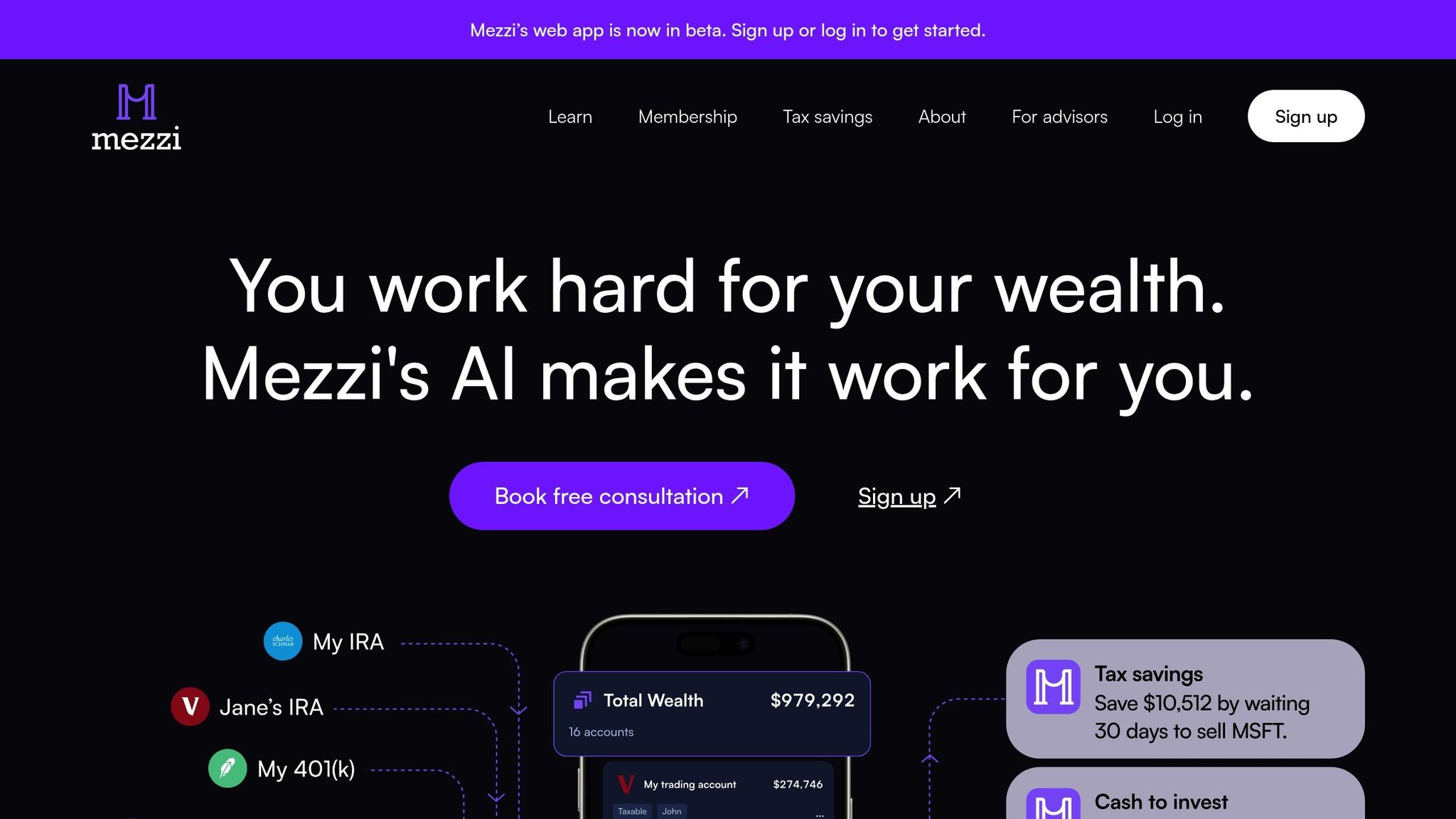
Mezzi is transforming how self-directed investors approach tax-loss harvesting, leveraging AI to tackle challenges like wash sales and real-time portfolio management. Its platform offers three standout features designed to help you save more on taxes while keeping control of your investments.
All Accounts in One View
Effective tax-loss harvesting starts with a clear, unified view of your finances. Mezzi brings all your investment accounts together into a single dashboard, giving you a complete picture of your portfolio. This isn't just about convenience - having everything in one place allows the AI to analyze your entire portfolio in real-time, uncovering opportunities to optimize across accounts.
For example, the platform can identify cases where gains in one account could be offset by harvesting losses in another. Manually spotting these opportunities across multiple accounts would be nearly impossible, but Mezzi's AI handles it seamlessly.
To make this possible, Mezzi uses secure aggregators like Plaid and Finicity to link your accounts. Your data stays protected while the AI gets the information it needs to make smarter, more informed recommendations. This comprehensive approach ensures no tax-saving opportunity slips through the cracks.
Advanced Tax Optimization Tools
Mezzi's AI doesn't just identify losses - it tackles the most complex parts of tax-loss harvesting. One of its key features is preventing wash sales across multiple accounts, a task that’s notoriously difficult to manage manually. The AI keeps an eye on your entire portfolio, flagging potential violations and suggesting alternative investments to preserve your tax benefits.
The platform also provides instant alerts for new tax-loss opportunities. Instead of waiting for quarterly reviews, you’ll get notified immediately when market conditions create chances to harvest losses. This real-time advantage is especially valuable during volatile market periods, where timing can make all the difference.
Another standout tool is Mezzi’s X-Ray feature, which digs deep into your portfolio to uncover hidden exposures. It identifies when seemingly unrelated investments actually overlap in risk or sector, helping you avoid wash sale violations while staying aligned with your investment strategy.
With these advanced tools, Mezzi empowers you to navigate the complexities of tax-loss harvesting with confidence.
Tools for Self-Directed Investors
For self-directed investors, Mezzi offers a way to access sophisticated tax strategies without relying on expensive advisors. The platform estimates users could save over $1 million in fees over 30 years by using its tools instead of traditional advisory services.
Mezzi puts professional-grade insights directly in your hands. Its unlimited AI chat and performance analysis not only provide actionable recommendations but also explain the reasoning behind them. This educational element is perfect for investors who want to stay in control while making informed decisions.
The platform also includes a Financial Calculator that factors in asset manager fees when projecting retirement savings. This transparency helps you weigh the long-term costs of traditional advisors against the benefits of AI-driven self-management. With Mezzi, you get the best of both worlds: advanced financial tools and the freedom to make your own decisions.
sbb-itb-e429e5c
Best Practices for AI Tax-Loss Harvesting
To get the most out of AI tax-loss harvesting, it's essential to focus on accurate data, proper timing, and staying compliant with IRS regulations. These steps work hand-in-hand with the technical strategies already covered.
Keep Account Information Updated
Accurate, up-to-date investment data is the backbone of effective AI-driven tax-loss harvesting. If your data is outdated, you risk missing opportunities or receiving flawed recommendations.
Set up automatic data feeds to ensure your platform always has access to the latest portfolio values, transaction history, and holdings. Make it a habit to review your connected accounts monthly. This includes checking for dividend reinvestments, stock splits, and any trades made outside the platform. These details are crucial for maintaining precise cost basis calculations and ensuring compliance with wash sale rules.
If your tax filing status, income, or investment goals change, update your personal information immediately. These factors can significantly impact which tax-loss opportunities are most beneficial for you.
Review AI Recommendations Regularly
AI tools can provide excellent insights, but the final decisions are in your hands. Schedule weekly reviews of AI-generated recommendations, especially during volatile market periods when opportunities can quickly change.
Avoid auto-executing suggestions. Instead, evaluate whether each recommendation aligns with your long-term investment goals and risk tolerance. Timing matters - a position that seems like a good tax-saving move today might recover before you act.
Most platforms include educational resources that explain the reasoning behind their recommendations. Take advantage of these tools to understand the "why" behind suggested trades. Tracking your results over time, such as measuring tax savings against your overall investment returns, can also help you refine your strategy.
Stay Updated on Tax Rule Changes
Tax laws are constantly evolving, and staying informed is key to maintaining compliance and maximizing tax-loss harvesting benefits.
Subscribe to IRS updates or tax law newsletters to stay in the loop. For instance, if your capital losses exceed your gains, you can reduce your taxable income by up to $3,000 per year, with any leftover losses carrying forward to future years. Keeping an eye on tax rule changes helps you avoid mistakes, and consulting a tax professional throughout the year can provide additional peace of mind.
The Future of AI Tax Optimization
AI-powered tax-loss harvesting is no longer just a niche tool - it’s quickly becoming a go-to strategy for investors, thanks to advancements in automation and machine learning. These technologies are pushing tax optimization far beyond traditional methods, making it more accessible and effective than ever.
The financial services industry is embracing AI at a rapid pace. Recent data shows that 49% of technology leaders report AI is now "fully integrated" into their companies' core strategies, while 73% of executives plan to use generative AI to reshape their business models. This widespread adoption is paving the way for regulatory frameworks that encourage innovation.
Governments are increasingly easing restrictions to promote AI investment. By striking a balance between innovation and compliance, these regulatory changes create an environment where companies can develop cutting-edge tools while adhering to tax laws and protecting user data.
One standout in this transformation is Mezzi, a platform leveraging advanced AI and machine learning to bring intelligent tax optimization to self-directed investors. With features like automated wash sale prevention and unified portfolio management, Mezzi is setting a new standard for personalized, intelligent financial guidance.
The future of tax optimization will be shaped by efficient and resource-conscious AI systems. As 63% of leading companies boost their cloud budgets to harness generative AI, platforms like Mezzi are focusing on building systems that deliver powerful results without unnecessary resource consumption. This approach ensures that these tools remain affordable and accessible for individual investors.
What’s next? The most successful AI tax optimization platforms will seamlessly combine real-time market analysis, strict regulatory compliance, and user-friendly interfaces. These systems will adapt to evolving tax laws, uncover complex opportunities across multiple accounts, and execute strategies with precision that outpaces human capabilities.
As these tools continue to evolve, they will further democratize sophisticated financial strategies. For self-directed investors, this means gaining access to advanced tax optimization solutions that were once reserved for institutions - without the high fees or account minimums. This shift is transforming wealth management, putting powerful financial tools into the hands of anyone looking to maximize their investment returns.
FAQs
How does AI-driven tax-loss harvesting help comply with IRS wash sale rules across multiple accounts?
AI-powered tax-loss harvesting leverages sophisticated algorithms to keep an eye on trades across all your accounts. It ensures compliance with IRS wash sale rules by preventing repurchases of the same or substantially identical securities within the 30-day window.
By automating this process, AI takes the headache out of manually tracking transactions. This reduces the chance of errors and helps fine-tune your tax strategy, saving you time and effort.
What are the risks of using AI for tax-loss harvesting, and how can investors reduce them?
Risks of AI-Driven Tax-Loss Harvesting
AI-driven tax-loss harvesting can be a game-changer for managing tax strategies, but it’s not without its challenges. These systems can sometimes struggle with nuanced or complex tax scenarios, which might result in missed opportunities or even unintended tax consequences. During periods of market volatility, AI tools may not perform as effectively, and they might lag in adapting to new or updated tax regulations.
To navigate these challenges, it’s important to view AI as a helpful assistant, not a complete substitute for human expertise. By regularly reviewing the recommendations generated by AI and consulting with a seasoned tax professional, investors can ensure compliance with tax laws while optimizing savings. This approach strikes a balance - leveraging AI’s efficiency while keeping potential risks in check.
How does AI-driven tax-loss harvesting adjust to changes in tax laws and market conditions to benefit investors?
AI-powered tax-loss harvesting leverages real-time data and predictive algorithms to keep up with shifting tax laws and market conditions. By constantly analyzing updates in regulations and market trends, it can pinpoint opportunities to offset gains and reduce tax liabilities.
This approach ensures strategies stay in sync with the latest legal and economic landscapes, helping investors reduce their tax burdens while remaining compliant. Even during market turbulence or changes in regulations, these smart adjustments offer a forward-thinking way to enhance financial outcomes.
Related Blog Posts
Table of Contents
Book Free Consultation
Walk through Mezzi with our team, review your current situation, and ask any questions you may have.