
When it comes to tactical asset allocation, the debate often revolves around AI vs. human bias in portfolio decisions. AI processes vast datasets in seconds, making objective, real-time decisions free from emotional biases like fear or greed. On the flip side, human investors bring context, experience, and the ability to interpret unique situations, such as geopolitical shifts or market anomalies.
For individual investors, the best results often come from combining these strengths. AI can optimize your investment returns by handling heavy data analysis, while human oversight ensures decisions align with broader market realities and personal goals. Platforms like Mezzi make this hybrid approach accessible, offering AI-powered insights for just $199 annually, helping investors reduce costly emotional mistakes while staying in control.
Key takeaways:
- AI excels at speed, consistency, and large-scale data processing.
- Humans add value through judgment, flexibility, and qualitative analysis.
- A hybrid approach balances AI's precision with human intuition for better outcomes.
This balance is reshaping how investors approach tactical asset allocation, making smarter, more informed decisions possible for everyone.
Use of Deep Learning in Tactical Multi-Asset Strategies with Calvin Yu
AI in Tactical Asset Allocation: Benefits and Drawbacks
AI is transforming tactical asset allocation by providing fast, data-driven insights that help investors make better decisions. However, this technology also comes with challenges, requiring careful consideration before integrating it into investment strategies.
Data-Driven Decision-Making
One of AI's biggest strengths is its ability to process massive amounts of market data - something that can easily overwhelm human analysts. AI systems can analyze economic indicators, earnings reports, market sentiment, and technical patterns in real time. This allows them to spot subtle correlations and emerging trends that human analysts might take weeks or even months to identify.
The speed advantage is particularly important in tactical asset allocation. For instance, while a portfolio manager might spend hours reviewing quarterly earnings reports, an AI system can process the same data in seconds. It can also cross-reference this information with historical performance, sector trends, and broader macroeconomic indicators. This rapid analysis enables timely adjustments to portfolios, helping investors seize short-lived market opportunities.
AI also brings consistency to the decision-making process. Unlike humans, AI systems don’t get tired or miss details due to cognitive overload. They apply the same rigorous methodology to every data point, minimizing the risk of oversight. This consistency becomes even more valuable when eliminating emotional biases from investment decisions.
Eliminating Emotional Biases
Another major advantage of AI is its immunity to emotional decision-making. Human investors often fall victim to behavioral biases that can hurt returns. For example, fear can drive investors to sell during market downturns, while greed may lead to chasing market peaks.
Take the March 2020 market crash as an example. Many investors panicked and sold their positions as the S&P 500 plummeted. An AI system, on the other hand, would evaluate the situation objectively, analyzing factors like corporate balance sheets, government stimulus measures, and historical recovery patterns. It wouldn’t be swayed by fear or uncertainty.
Similarly, AI avoids common pitfalls like loss aversion, where investors hold onto losing positions for too long or sell winning ones too quickly. Instead, it focuses on forward-looking probabilities and expected returns. This is where AI scenario tools can provide deeper insights into potential outcomes. However, while AI reduces emotional bias, it isn’t without its own set of challenges, particularly when it comes to data quality and adaptability.
AI Limitations in Tactical Allocation
Despite its strengths, AI has notable limitations. Its effectiveness depends heavily on the quality of the data it processes. Poor or incomplete data can lead to flawed decisions. Market data can be noisy, subject to revisions, or riddled with reporting errors, all of which can throw off AI algorithms and result in less-than-optimal asset allocations.
"The integration of AI into investment strategies is not without challenges, including the need for high-quality data and the potential for overreliance on technology."
– alphaAI
Another concern is overreliance on AI. Many systems are built using historical market patterns, which may not hold up during unprecedented events or structural changes in the market. In such situations, human judgment becomes critical, especially when dealing with factors like regulatory changes or geopolitical tensions that AI might not fully grasp.
The "black box" nature of some AI models also poses a challenge. These systems can make decisions that are difficult for investors to understand, which could undermine confidence during volatile periods.
Industry experts acknowledge these limitations and emphasize that AI should complement, not replace, human judgment.
"Consensus view is that AI will enhance, rather than replace, the role fund managers and asset allocators play in the industry, where investment professionals apply the technology in business matters."
– Investec
The most effective approach to tactical asset allocation appears to be a combination of AI’s analytical capabilities and human expertise. Together, they offer a balanced strategy that leverages the strengths of both technology and human intuition.
Human Emotion in Tactical Asset Allocation: Benefits and Problems
AI may bring objectivity to investment decisions, but human emotion and intuition remain deeply intertwined with tactical asset allocation. To craft effective investment strategies, it’s essential to understand both the strengths and weaknesses of human decision-making.
Common Behavioral Biases in Investment Decisions
Investors, whether individuals or professionals, often fall prey to behavioral biases that can chip away at returns. Let’s explore some of the most common ones:
- Overconfidence bias: Many investors overestimate their ability to time the market, leading to excessive trading and poorly timed decisions that ultimately hurt long-term performance.
- Herding behavior: This bias occurs when investors follow the crowd, even when logic suggests otherwise. A classic example is the dot-com bubble of the late 1990s, where fund managers kept buying overvalued tech stocks simply because others were doing the same. This behavior inflated the NASDAQ to unsustainable levels before its crash between 2000 and 2002.
- Loss aversion: Losses tend to feel about twice as painful as equivalent gains feel rewarding. As a result, investors often hold onto losing positions far too long, hoping for a recovery, while selling winning positions too quickly to "lock in" profits.
- Recency bias: Investors often give disproportionate weight to recent events. For instance, after the 2008 financial crisis, many avoided stocks for years, missing the market’s strong rebound starting in 2009. This focus on recent losses blinded them to long-term historical patterns.
- Confirmation bias: This occurs when investors seek out information that supports their existing beliefs while ignoring evidence to the contrary. For example, a bullish investor in a specific sector might only pay attention to positive news, dismissing any warnings about potential risks.
Interestingly, these biases don’t just affect individual investors. Even professional fund managers, despite their training and experience, are not immune to these pitfalls. This often leads to underperformance compared to market benchmarks. However, despite these challenges, human judgment still offers valuable insights and adaptability that complement data-driven approaches.
The Benefits of Human Judgment
Human judgment brings depth and nuance that algorithms often overlook. Here’s how it adds value:
- Contextual understanding: Human investors can interpret market conditions through historical experience and broader societal knowledge, offering insights that data alone might miss.
- Recognizing unique scenarios: Humans excel at identifying situations beyond the scope of historical data. For instance, during the early days of the COVID-19 pandemic in March 2020, some fund managers anticipated a market recovery by understanding the likelihood of massive government intervention - something AI systems trained on past data struggled to predict, highlighting the need for AI scenario analysis to better manage risk.
- Flexibility and adaptability: When markets shift rapidly, human investors can adjust their strategies and assumptions on the fly. Unlike AI, which may require reprogramming, humans can pivot in real-time when existing models fall short.
- Qualitative analysis: Humans can spot factors like management quality, competitive threats, or regulatory changes that might not immediately appear in financial metrics. These insights often complement the precision of AI’s quantitative analysis.
- Synthesizing complex information: Investors can integrate data from diverse sources - financial reports, geopolitical developments, regulatory updates, and industry trends - to craft well-rounded investment strategies that go beyond pure number-crunching.
When Human Emotion Helps Investment Decisions
While emotional biases can hinder decision-making, certain emotional responses can actually enhance investment strategies:
- Healthy skepticism: A cautious approach can help investors avoid bubbles. For example, those who questioned the rapid rise of meme stocks in 2021 likely avoided significant losses when those stocks eventually plummeted.
- Intuitive pattern recognition: Years of experience in the market often build an investor’s ability to detect subtle shifts in dynamics. Warren Buffett’s decision to steer clear of tech stocks during the dot-com bubble wasn’t purely based on financial metrics; his intuition told him valuations were out of touch with reality.
- Risk sensitivity: Personal experiences with losses can sharpen an investor’s ability to manage risk effectively. Similarly, contrarian instincts - driven by emotional intelligence - can lead to profitable decisions when fear dominates the market, creating undervalued opportunities.
The key lies in controlled emotional responses. Successful investors learn to interpret their emotions as signals rather than letting them dictate actions. For example, fear might highlight potential risks, while excitement could signal overconfidence. By combining emotional insight with disciplined processes, investors can achieve a balanced and effective approach to tactical asset allocation.
When paired with systematic strategies, controlled emotional input adds a human touch that strengthens overall decision-making. Together, they create a more comprehensive framework for navigating complex market environments.
AI vs. Human Emotion: Direct Comparison
When it comes to tactical asset allocation, AI and human decision-making each bring unique strengths and weaknesses to the table. These differences directly influence investment outcomes, making it essential to understand how they compare.
Comparison Table: AI vs. Human Emotion
Here’s a side-by-side look at how AI and human emotion stack up across key performance factors:
| Factor | AI-Driven Approach | Human Emotion-Driven Approach |
|---|---|---|
| Speed | Real-time monitoring and instant trade execution | Slower, relying on periodic manual reviews |
| Consistency | Objective, data-based decisions | Subject to emotional swings and daily variability |
| Flexibility | Needs programming updates for new situations | Adapts quickly to unexpected market shifts |
| Transparency | Rule-based with clear logic | Often subjective and harder to explain |
| Bias Susceptibility | Free from emotions but can inherit data biases | Highly prone to behavioral biases |
| Data Processing | Handles massive datasets instantly | Limited by human cognitive capacity |
| Cost Efficiency | Operates at lower costs, easily scalable | Higher costs and limited scalability |
| Market Sentiment Analysis | Quantifies sentiment through sentiment analysis APIs | Reads subtle signals and interprets context intuitively |
AI thrives in fast-paced, volatile markets, capable of analyzing thousands of data points and executing trades in milliseconds. In contrast, human-driven decisions often take hours or even days. However, AI's rapid response can sometimes backfire when markets behave unpredictably, requiring nuanced judgment and contextual understanding that algorithms may lack.
The Case for Combining Both Approaches
Rather than choosing one over the other, blending AI with human expertise can yield better outcomes. Recent data supports this: in 2023–2024, a hybrid strategy using AI alongside human oversight achieved similar returns with reduced risk.
For instance, an AI tool named ALICE continuously processed vast amounts of economic, fundamental, and valuation data, identifying subtle shifts in asset class relationships that might escape human detection. At the same time, human portfolio managers stepped in to interpret ALICE's recommendations within a broader market context, ensuring that decisions aligned with current political, economic, and social conditions.
This hybrid model also addresses one of AI's key challenges - transparency. While AI delivers systematic, rule-based analysis, human involvement ensures decisions can be clearly communicated to clients and stakeholders. This becomes especially critical during market turbulence, when understanding the reasoning behind decisions is crucial for maintaining trust.
Risk management is another area where this combination shines. AI excels at mathematical risk modeling, quickly identifying when portfolios deviate from set risk parameters. Human judgment complements this by adding a qualitative layer, evaluating risks that numbers alone cannot capture. With AI technology becoming more accessible, the cost of integrating human oversight is often outweighed by the potential savings from avoiding costly allocation errors.
Mezzi's Approach: Using AI for Bias-Free Tactical Asset Allocation
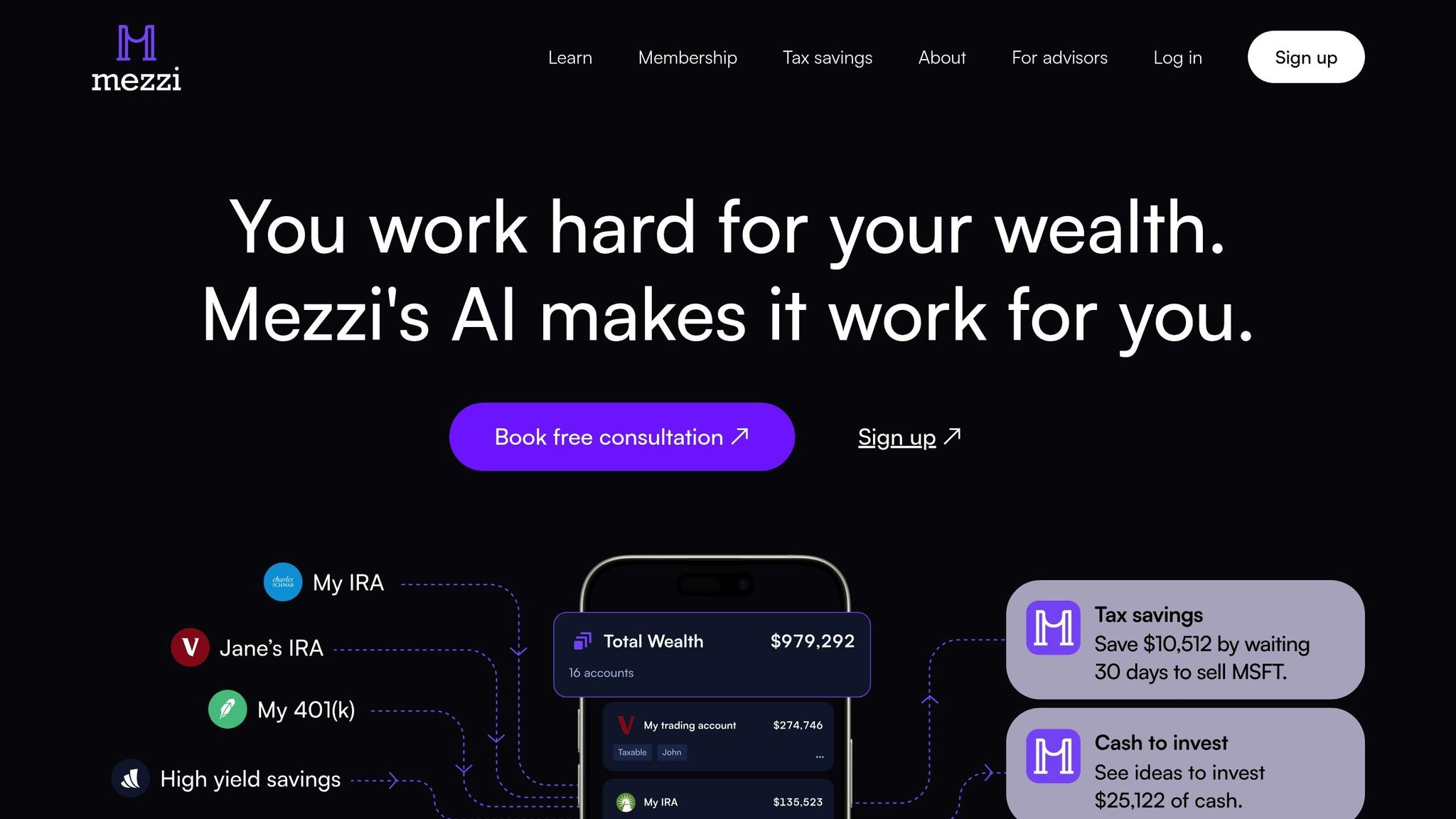
Mezzi pushes the boundaries of the hybrid investment model by equipping self-directed investors with AI-powered insights. Instead of relying on costly financial advisors to interpret data and provide recommendations, Mezzi’s platform offers advanced tactical asset allocation tools directly to individual investors. This method builds on the hybrid model by incorporating unbiased, real-time analytics that are accessible to everyone.
AI-Driven Insights for Smarter Decisions
Mezzi’s platform processes market data and portfolio metrics in real time, delivering personalized recommendations that help eliminate emotional decision-making. By identifying opportunities and flagging potential issues, the system empowers users to shift from passive monitoring to active, informed decision-making.
The platform excels at detecting subtle changes across linked accounts - patterns that might go unnoticed by human analysis. By offering objective, data-based guidance, Mezzi helps investors avoid decisions driven by fear or greed.
Using Mezzi is simple for self-directed investors: link financial accounts to the platform, set investment goals and risk preferences, and regularly review AI-generated recommendations. The platform handles the heavy analytical lifting, allowing users to make strategic, unbiased decisions with confidence.
Advanced Tax Optimization and Comprehensive Analysis
Mezzi goes beyond tactical advice to tackle some of the toughest challenges in portfolio management. One standout feature is its focus on tax efficiency across multiple accounts. The platform’s AI automatically identifies and prevents wash sales - a complex tax optimization strategy that typically requires professional guidance.
Another powerful tool is Mezzi’s X-Ray feature, which provides a detailed analysis of portfolio holdings. It identifies hidden stock exposures, concentration risks, and unintended overlaps across accounts, enabling users to make more informed allocation decisions. To further support investors, the platform includes financial calculators that account for asset manager fees, offering a clearer picture of long-term costs and returns.
Mezzi’s unified dashboard consolidates all financial accounts, giving users and the AI system a complete view of their portfolio. This comprehensive perspective allows the platform to provide tactical allocation recommendations that consider the entirety of an investor’s financial situation, rather than focusing on individual accounts in isolation.
Security and Accessibility for U.S. Investors
Security is a top priority for Mezzi. By partnering with trusted providers like Plaid and Finicity, the platform ensures secure account connections. It also offers Apple login for anonymized email access and maintains an ad-free environment, protecting user data and privacy.
For U.S. investors, Mezzi’s security-first approach removes common barriers to accessing advanced tactical asset allocation tools. The platform is designed to be affordable: a free tier covers basic features, while a $199 annual premium membership unlocks AI-driven insights. This pricing makes professional-grade portfolio management tools accessible to individuals who might otherwise find traditional financial advisors too expensive. With Mezzi, every tactical decision is informed, data-driven, and secure.
Conclusion: Balancing AI and Human Emotion in Future Investment Strategies
When it comes to tactical asset allocation, the conversation isn't about choosing between AI and human emotion - it's about striking the right balance to optimize your strategy. AI shines in its ability to sift through massive amounts of market data, free from the emotional biases that often cloud decision-making. It identifies trends, minimizes costly mistakes, and maintains discipline during volatile market conditions. On the other hand, human judgment adds depth, creativity, and the ability to navigate unique market situations that AI might not fully grasp.
The most effective investment strategies blend AI's analytical power with human oversight. This partnership is the essence of the article’s message: leveraging precise data alongside personal insight. AI takes on the heavy lifting - analyzing data, spotting opportunities, and flagging risks across your portfolio. This process is powered by AI's use of real-time data to ensure every decision is based on the latest market movements. Meanwhile, human judgment steps in to consider the nuances: personal goals, intuition, and broader market context that algorithms alone might overlook.
For individual investors, this hybrid approach is no longer out of reach. Platforms like Mezzi bring advanced investment tools to everyday investors for just $199 annually, making AI-driven insights accessible without the hefty fees of traditional advisors.
Looking forward, the future of tactical asset allocation lies in equipping investors with smarter tools - not replacing human decision-making. As AI continues to evolve, we can expect even more advanced platforms capable of handling complex financial scenarios while preserving the human element critical for strategic choices.
Ultimately, success comes down to knowing when to rely on data and when to trust your instincts - aided by the right tools to support both.
FAQs
How does combining AI and human expertise improve tactical asset allocation?
How AI and Human Expertise Work Together in Tactical Asset Allocation
The partnership between AI and human expertise brings a powerful edge to tactical asset allocation by combining the unique strengths of both. AI is unmatched in its ability to process massive volumes of real-time data, uncover patterns, and eliminate emotional biases that often lead to poor decisions. On the other hand, human judgment contributes intuition, creativity, and strategic thinking, all of which are crucial for grasping intricate market dynamics and aligning with long-term objectives.
This blend of technology and human insight results in a well-rounded, flexible strategy that supports smarter, more agile investment decisions. By pairing AI's analytical precision with the nuanced expertise of human professionals, investors are better equipped to handle market volatility and work toward achieving their financial goals.
What are the risks of relying only on AI for investment decisions?
AI brings impressive tools to the table for making investment decisions, but depending on it entirely isn’t without risks. For one, AI systems can sometimes generate inaccurate predictions. This can happen due to flawed data or unexpected events, potentially leading to financial losses. Plus, AI often struggles to fully grasp individual investment goals or quickly adjust to sudden shifts in the market.
Another concern is the risk of bias within AI algorithms, which could unintentionally favor specific outcomes. Over-relying on AI might also erode critical thinking skills, leaving investors less equipped to make independent, well-rounded decisions. The smartest strategy? Pairing AI-driven insights with human expertise. This blend ensures a more balanced and thoughtful approach to navigating the complexities of investing.
How can investors use AI tools like Mezzi to improve their investment strategies?
Investors looking to refine their strategies can turn to AI tools like Mezzi, which offers powerful analytics and smart tax optimization features. These tools help reduce tax burdens while simplifying decision-making processes. Mezzi's AI-driven insights work to eliminate emotional biases, pinpoint the best asset allocations, and handle repetitive tasks, freeing up time for more strategic financial management.
With the ability to consolidate all financial accounts into one streamlined platform, Mezzi delivers real-time, tailored recommendations based on individual goals. This setup allows investors to respond swiftly to market shifts, fine-tune their strategies, and grow their wealth faster - all while cutting down on unnecessary expenses and saving valuable time.
Related Blog Posts
Table of Contents
Book Free Consultation
Walk through Mezzi with our team, review your current situation, and ask any questions you may have.