
When the Federal Reserve cuts interest rates, covered-call ETFs face a unique challenge. These funds generate income by selling call options on stocks they own, but rate cuts often lead to lower option premiums and higher stock prices. This can reduce income potential while capping gains if stocks rally.
Key points to consider:
- Lower yields: Rate cuts reduce market volatility, shrinking option premiums and income.
- Capped upside: Stocks may rise, but gains are limited if options are exercised.
- ETFs differ: Funds like XYLD focus on steady income, QQQX adjusts for growth, and JEPI balances income with market participation.
For income-focused investors, covered-call ETFs remain appealing during rate cuts, but understanding their trade-offs is crucial. Each fund offers a different mix of income, growth potential, and risk, making it important to align choices with your financial goals.
Covered-Call ETFs Are Booming. But Not All Yield Is Good
1. XYLD (Global X S&P 500 Covered Call ETF)
XYLD mirrors the S&P 500 while employing a covered call strategy to generate extra income. Let’s break down how this approach impacts the fund's yield, potential for gains, and risk profile.
Yield Performance
When interest rates are reduced, the premiums earned from selling call options tend to shrink. This happens because lower rates often go hand-in-hand with reduced market volatility. As the Federal Reserve lowers rates to encourage economic growth, the resulting dip in volatility can further limit income from option premiums. However, this strategy can still appeal to investors during times when traditional fixed-income yields are less attractive.
Upside Capture
Selling call options inherently limits the potential for capital gains. Even when the underlying index performs well, modest price increases can lead to the options being exercised, effectively capping the ETF's gains. Since these options are typically written near the current market price, the fund can only participate in a portion of the market's upward movement during rate cut periods, even when investor sentiment improves.
Risk and Downside Protection
While the premiums collected from selling call options provide some buffer against losses, they don't fully shield the ETF from significant declines during severe market downturns. The covered-call strategy does help reduce the fund's overall sensitivity to market swings, but XYLD still largely follows broader market trends. In a rate-cutting environment, this combination could potentially heighten the overall risk exposure.
2. QQQX (Nuveen NASDAQ 100 Dynamic Overwrite Fund)
QQQX mirrors the NASDAQ 100 but takes a flexible approach with its dynamic overwrite strategy. This method adjusts the fund's call option coverage depending on market conditions, making it particularly effective during periods of rate cuts. Unlike fixed covered-call strategies, QQQX adapts to changing environments, as outlined below.
Yield Performance
With its dynamic strategy, QQQX can adjust how it generates income when interest rates drop. During rate cuts, fund managers reduce call option coverage, which helps maintain income levels. At the same time, the NASDAQ 100's tech-heavy focus tends to benefit from lower borrowing costs, creating a favorable environment for the fund.
Upside Capture
The fund's flexible overwrite method allows it to seize more growth potential during market upswings following rate cuts. Managers actively adjust call coverage to align with these growth phases, offering a level of adaptability that contrasts with the fixed approach seen in XYLD. This flexibility helps QQQX strike a balance between income and capital appreciation.
Risk and Downside Protection
The dynamic nature of QQQX introduces a different risk profile. By lowering call coverage during certain periods, the fund may offer less downside protection compared to full-coverage strategies. However, this trade-off enhances its ability to capture gains during favorable market conditions. While the fund still generates income from option premiums, which can help offset losses, its variable approach stands apart from XYLD's consistent coverage model.
sbb-itb-e429e5c
3. JEPI (JPMorgan Equity Premium Income ETF)
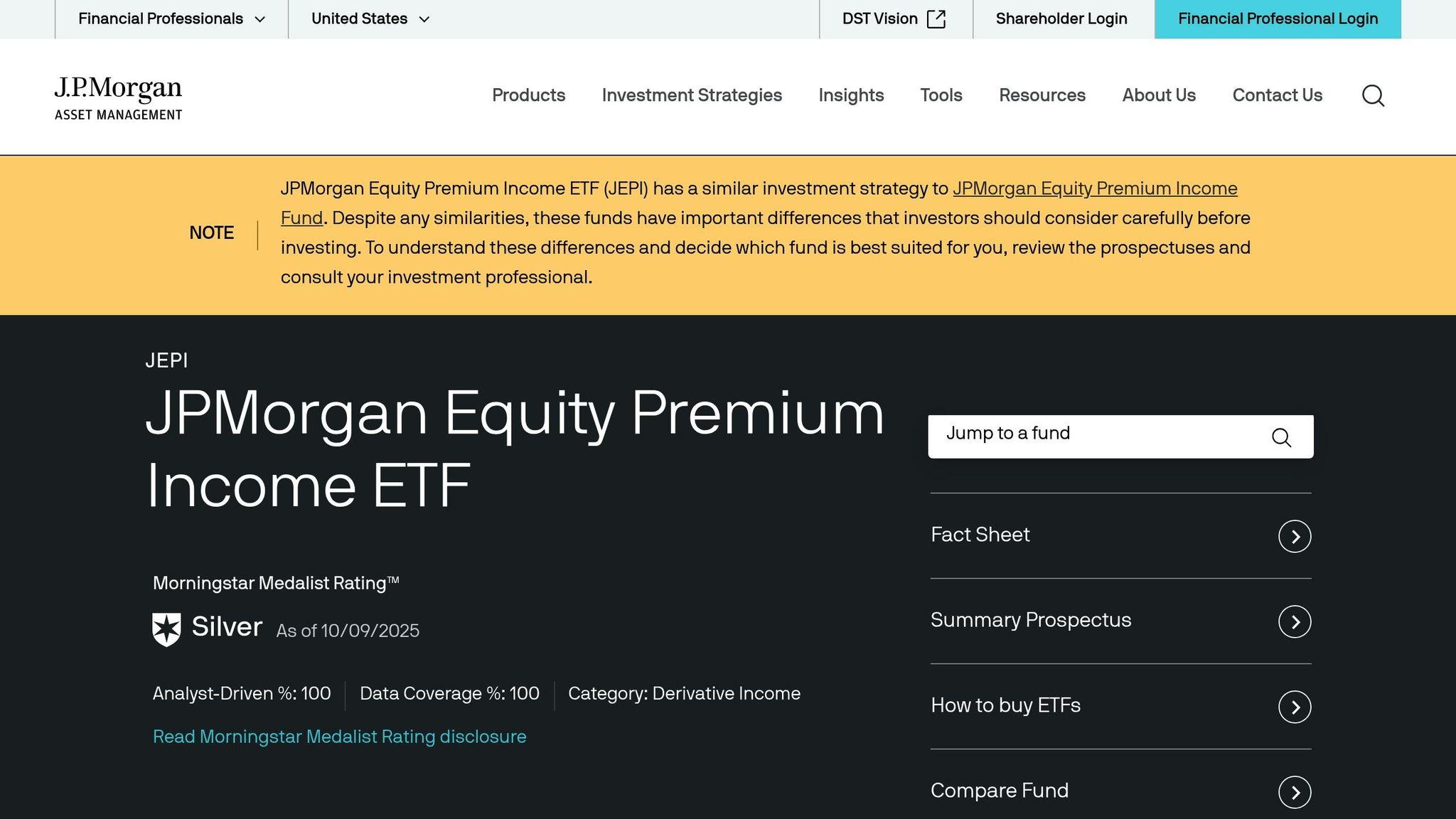
JEPI combines equity investments with an active options strategy to generate income. Unlike ETFs that rely solely on selling call options, JEPI strikes a balance between earning income and participating in the equity market. This approach becomes especially useful during periods of rate cuts, as it helps manage the trade-off between maintaining yields and benefiting from market growth.
Yield Performance
In a rate-cut scenario, JEPI’s strategy helps stabilize yields by generating premiums through its options overlay. At the same time, lower interest rates tend to support stock market performance. The fund’s active management adjusts the options strategy as markets shift, aiming to sustain income while still benefiting from market rallies.
Upside Capture
JEPI is built to take advantage of market gains while continuing to generate income through option premiums. Since only part of the portfolio is covered by the options strategy, a significant portion of its equity holdings can still benefit from market upswings during favorable conditions.
Risk and Downside Protection
The income from JEPI’s options overlay can provide some buffer against market declines. However, its equity exposure means it remains vulnerable to market volatility. During a rate-cut environment, lower interest rates often support equity valuations, potentially reducing overall market turbulence. Additionally, the fund’s active management allows for adjustments to risk levels as market dynamics evolve.
Pros and Cons
Covered-call ETFs present distinct trade-offs during rate-cutting periods, balancing income generation with growth potential.
When rates are cut, XYLD offers steady income through its systematic covered-call strategy on the S&P 500. With yields that surpass those of traditional dividend ETFs, it’s an appealing option for income-focused investors. However, this income comes with a trade-off: limited upside potential. In a market rally, XYLD investors miss out on larger gains due to the cap imposed by its call options. On the bright side, the strategy offers some downside protection during market declines.
Meanwhile, QQQX provides exposure to high-growth tech stocks via the NASDAQ 100, while also generating additional income. Its more flexible approach to option strategies allows for greater potential upside compared to systematic methods. Plus, tech companies often excel in low-rate environments, adding to its appeal. However, QQQX comes with higher volatility, driven by its focus on high-growth tech. Additionally, its options overlay still limits returns during strong market rallies, and its performance heavily relies on the tech sector’s trajectory.
Lastly, JEPI takes a balanced approach, blending equity investments with selective options strategies. This setup enables the fund to participate more in market upswings while still generating meaningful income. Its active management allows for adjustments based on market conditions, offering more adaptability than fully systematic strategies. JEPI also provides better downside protection thanks to its diversified equity holdings. The downside? Higher expense ratios due to active management and the fund’s dependence on managerial decisions.
| ETF | Yield Potential | Upside Capture | Risk Management | Ideal For |
|---|---|---|---|---|
| XYLD | High, consistent | Limited | Protection | Maximum current income |
| QQQX | Moderate to high | Limited | Moderate volatility | Tech exposure with income |
| JEPI | Moderate | Good participation | Better downside buffer | Balanced income and growth |
In a rate-cutting environment, JEPI strikes the best balance between income and growth potential. XYLD is ideal for those prioritizing immediate income, while QQQX caters to investors seeking tech exposure with an added income boost. Choosing the right ETF depends on whether the investor values maximum income or prefers some upside potential during market rallies. Each option comes with its own set of trade-offs tailored to different financial goals.
Conclusion
Investing in covered-call ETFs during periods of rate cuts presents a clear trade-off between generating income and capturing growth. These funds often deliver consistent income when traditional fixed-income yields dip, but they can cap potential gains during market rallies that often follow rate cuts.
Each ETF has its own focus: XYLD emphasizes generating high current income, QQQX strikes a balance between tech-driven growth and income, and JEPI offers a mix of income generation with broader market participation.
Given these differences, investors should consider adjusting their allocations based on evolving market conditions. Tools like Mezzi's AI-powered analytics can facilitate these tactical shifts, helping investors manage risk and optimize yields. By providing a detailed view of portfolio exposure across multiple accounts, Mezzi ensures that risks are carefully managed while pursuing steady income.
For example, at the start of a rate-cut cycle, a balanced strategy similar to JEPI’s may be ideal. As markets stabilize, an approach resembling QQQX might better capture both income and growth opportunities. For retirees or those focused on generating current income, XYLD remains a reliable choice, even with its limited growth potential. The key lies in flexibility and leveraging data-driven insights to navigate these shifts effectively.
FAQs
How do covered-call ETFs generate income during rate cuts when option premiums are lower?
Covered-call ETFs create income by writing call options on the stocks they own, collecting premiums from these option trades. Even when interest rates drop - potentially lowering option premiums - this approach consistently delivers a dependable income stream for investors.
Although reduced premiums might slightly impact the total income, the predictable structure of the covered-call strategy ensures investors continue to enjoy steady cash flow. This makes covered-call ETFs an appealing choice for those prioritizing income, even as interest rates fluctuate.
How do XYLD, QQQX, and JEPI compare in terms of risk and returns during a rate-cutting environment?
Covered-call ETFs like XYLD, QQQX, and JEPI each come with their own set of risks and potential rewards, especially during periods of interest rate cuts. These ETFs generate income by selling call options, which can limit their ability to fully benefit from sharp increases in the prices of their underlying stocks.
JEPI often performs more favorably in high-volatility markets, thanks to its reliance on option premiums for generating income. However, during low-volatility periods - like those often associated with rate cuts - its income potential may decrease. On the other hand, XYLD and QQQX, which use more traditional covered-call strategies, could experience lower total returns in such environments as they prioritize steady income over growth.
When evaluating these ETFs, it’s important to consider the trade-offs between consistent income and growth potential. Striking the right balance between risk and reward is key to positioning your portfolio for long-term success.
Why might an investor prefer a covered-call ETF like JEPI instead of traditional fixed-income options during interest rate cuts?
During times when interest rates are being cut, covered-call ETFs like JEPI can catch the eye of income-focused investors. These funds aim to offer higher income opportunities compared to traditional fixed-income investments. The strategy they employ - selling call options on the underlying assets - creates an additional income stream. This often results in yields that surpass those of bonds or other fixed-income options.
What makes these ETFs even more appealing is their ability to provide some exposure to equity market growth. However, it’s important to note that the upside is limited because of the call options sold. For those looking to strike a balance between generating income and achieving modest growth in a declining rate environment, covered-call ETFs can serve as a compelling alternative to bonds or other income-focused investments.
Related Blog Posts
- How does JEPI’s yield and risk profile compare to SCHD and DIVO for an income portfolio?
- JEPI vs JEPQ: which is better for equity income and drawdown control?
- SPYI vs QYLD vs XYLD: covered-call income tradeoffs for a taxable account.
- If the Fed cuts rates, how might SPYI and DIVO behave versus a plain S&P 500 ETF?
Table of Contents
Book Free Consultation
Walk through Mezzi with our team, review your current situation, and ask any questions you may have.