
Dynamic rebalancing is transforming how portfolios are managed. Unlike static methods that adjust investments on a fixed schedule, dynamic rebalancing uses AI to make real-time decisions. By constantly analyzing markets, AI ensures portfolios stay aligned with goals, reacting instantly to changes and opportunities. This approach minimizes risks, maximizes growth potential, and removes emotional decision-making from the process.
AI leverages machine learning, predictive analytics, and automation to handle complex calculations, monitor global markets 24/7, and execute trades within milliseconds. Tools like natural language processing (NLP) even assess news and sentiment to anticipate market shifts. This precision not only reduces errors but also enhances efficiency, making wealth management smarter and faster.
Platforms like Mezzi bring these capabilities to individual investors. With features like real-time tax alerts, portfolio analysis, and cost-saving automation, Mezzi simplifies dynamic rebalancing, saving both time and money. Whether you're managing a simple or complex portfolio, AI-driven systems offer a modern way to grow wealth in an ever-changing market.
How AI Powers Dynamic Rebalancing
AI Technologies Behind Dynamic Rebalancing
Making real-time adjustments in financial portfolios demands precision, and AI delivers this with advanced tools. At the heart of AI-powered dynamic rebalancing are machine learning algorithms, which analyze market data to refine investment decisions over time. Unlike traditional systems that follow fixed rules, these models evolve by adapting to new information and shifting market conditions.
Adding to this capability is predictive analytics, which forecasts future market movements. By analyzing extensive market and economic data, predictive tools uncover patterns that might escape human analysts, helping anticipate how different scenarios could influence portfolio performance.
Natural language processing (NLP) brings another dimension to the table. By analyzing news articles, earnings call transcripts, and even social media sentiment, NLP can quickly determine whether market news is positive, negative, or neutral. For instance, if NLP detects widespread negative sentiment about a specific sector, the system might reduce portfolio exposure to that sector before the broader market reacts.
Finally, automation engines ensure these insights are acted upon instantly. When adjustments are needed, trades are executed in milliseconds, preventing missed opportunities due to manual delays. This lightning-fast execution is especially critical in volatile markets, where prices can shift dramatically in moments.
Real-Time Market Response
AI's ability to respond in real time hinges on its speed and pattern recognition capabilities. These systems continuously monitor global markets, processing live data feeds to detect significant changes. For example, if the S&P 500 drops 2% within an hour or bond yields surge unexpectedly, AI systems can act immediately without waiting for the next scheduled review.
Pattern recognition allows AI to spot emerging trends and make proactive adjustments before market movements escalate.
Volatility monitoring further enhances this responsiveness. By analyzing volatility patterns, AI distinguishes between short-term fluctuations and meaningful shifts, ensuring the system avoids unnecessary trades while reacting appropriately to significant changes.
Through cross-asset analysis, AI evaluates how different investments interact in real time. For example, if technology stocks are climbing while utility stocks decline, the system can determine whether this indicates a broader market shift that warrants portfolio rebalancing. This comprehensive perspective ensures decisions account for the entire investment landscape rather than isolated asset movements.
Reducing Human Error and Improving Efficiency
AI doesn't just respond quickly - it also brings a level of precision that minimizes human error. One of its standout advantages is emotional neutrality. Unlike human advisors, AI remains unaffected by market sentiment or external pressures, ensuring decisions are driven purely by data.
Its ability to handle complex calculations is another game-changer. While a human might struggle to assess tax implications, risk metrics, and correlation effects across hundreds of trades simultaneously, AI processes these factors instantly. This ensures every rebalancing decision is grounded in a thorough analysis of all relevant variables.
Consistency in execution is another strength. AI applies the same rigorous logic to every decision, eliminating variability caused by human factors like mood, workload, or bias. This consistency is particularly valuable during high-stress market periods when human judgment might falter.
Furthermore, AI operates with 24/7 monitoring. Unlike humans, it doesn't need sleep or breaks, enabling it to track global markets across time zones and react to events at any hour. This constant vigilance ensures portfolios are managed optimally, even when human advisors are unavailable.
Lastly, error reduction through automation prevents costly mistakes. AI systems don't miscalculate, forget to execute trades, or input incorrect amounts. This level of precision safeguards portfolios from errors that could erode wealth over time, ensuring steady, reliable growth through continuous and flawless management.
Comparing Static and Dynamic Rebalancing
Key Differences Between Static and Dynamic Methods
Static rebalancing follows a fixed schedule, such as quarterly, semi-annually, or annually, without considering market conditions. In contrast, dynamic rebalancing reacts in real time, adjusting instantly based on market data. This difference makes static methods more rigid, while dynamic systems - often powered by AI - are highly adaptable to market shifts.
Dynamic rebalancing relies on continuous monitoring of market conditions. It reacts to changes like increased volatility, shifting asset correlations, or emerging opportunities. This real-time approach can seize gains that static methods, with their delayed reactions, might overlook.
Cost structures vary as well. Static rebalancing often incurs higher transaction costs due to infrequent but significant portfolio adjustments. Dynamic rebalancing, on the other hand, typically involves smaller, more frequent trades, which can help reduce overall costs.
Risk management also sets these methods apart. Static rebalancing may leave portfolios vulnerable to unfavorable market conditions until the next scheduled adjustment. Dynamic systems, however, continuously monitor and adjust exposure, offering more consistent protection.
| Aspect | Static Rebalancing | Dynamic Rebalancing |
|---|---|---|
| Timing | Fixed schedule (e.g., quarterly/yearly) | Real-time, responsive adjustments |
| Decision Making | Rule-based and predetermined | AI-driven and adaptive |
| Market Response | Slower reaction to changes | Immediate adjustments |
| Transaction Costs | Higher due to larger periodic moves | Potentially lower with smaller trades |
| Risk Management | Periodic adjustments | Continuous risk monitoring |
| Complexity | Simple and predictable | Automated and sophisticated |
| Time Investment | Focused on set dates | Ongoing, automated monitoring |
These differences highlight the strengths and limitations of each approach, helping investors determine which method best suits their portfolio needs.
When to Use Static vs. Dynamic Rebalancing
Choosing the right rebalancing strategy depends on your portfolio's complexity, market conditions, and personal investment goals.
Static rebalancing is ideal for straightforward portfolios with a limited number of asset classes. It appeals to investors who prefer predictable, scheduled adjustments. However, this method can struggle in volatile markets. For example, during sharp market downturns or rapid recoveries, static rebalancing might fail to act quickly, leading to missed opportunities or prolonged exposure to risk.
Dynamic rebalancing, on the other hand, shines in managing complex portfolios with diverse assets. Continuous monitoring allows for timely adjustments, which are particularly valuable when dealing with intricate relationships between different holdings. Dynamic systems can also improve tax efficiency by optimizing strategies like loss harvesting and timing transactions to minimize tax impacts - something static schedules often cannot achieve.
High-net-worth investors may find dynamic rebalancing especially advantageous. Even small improvements in timing or tax strategies can lead to considerable wealth growth. Additionally, during life events such as retirement planning, income changes, or other financial transitions, dynamic systems can adapt strategies in real time, offering a level of responsiveness that static methods lack.
In stable, predictable markets, static rebalancing might suffice. However, in fast-moving or uncertain environments, dynamic rebalancing provides a clear edge, helping investors protect and grow their wealth more effectively. The choice ultimately depends on your investment style, portfolio intricacy, and how much time you're willing to dedicate to managing your assets.
Benefits of AI-Driven Dynamic Rebalancing for Wealth Growth
Maximizing After-Tax Returns
AI-driven dynamic rebalancing helps boost after-tax returns by incorporating daily tax-loss harvesting techniques. It also allows for tailored rebalancing strategies that align with each client's specific goals and tax circumstances. This precise method reduces tax burdens while creating opportunities for consistent, long-term wealth growth.
sbb-itb-e429e5c
Could AI manage your portfolio better than a human?
How Mezzi Simplifies AI-Driven Rebalancing
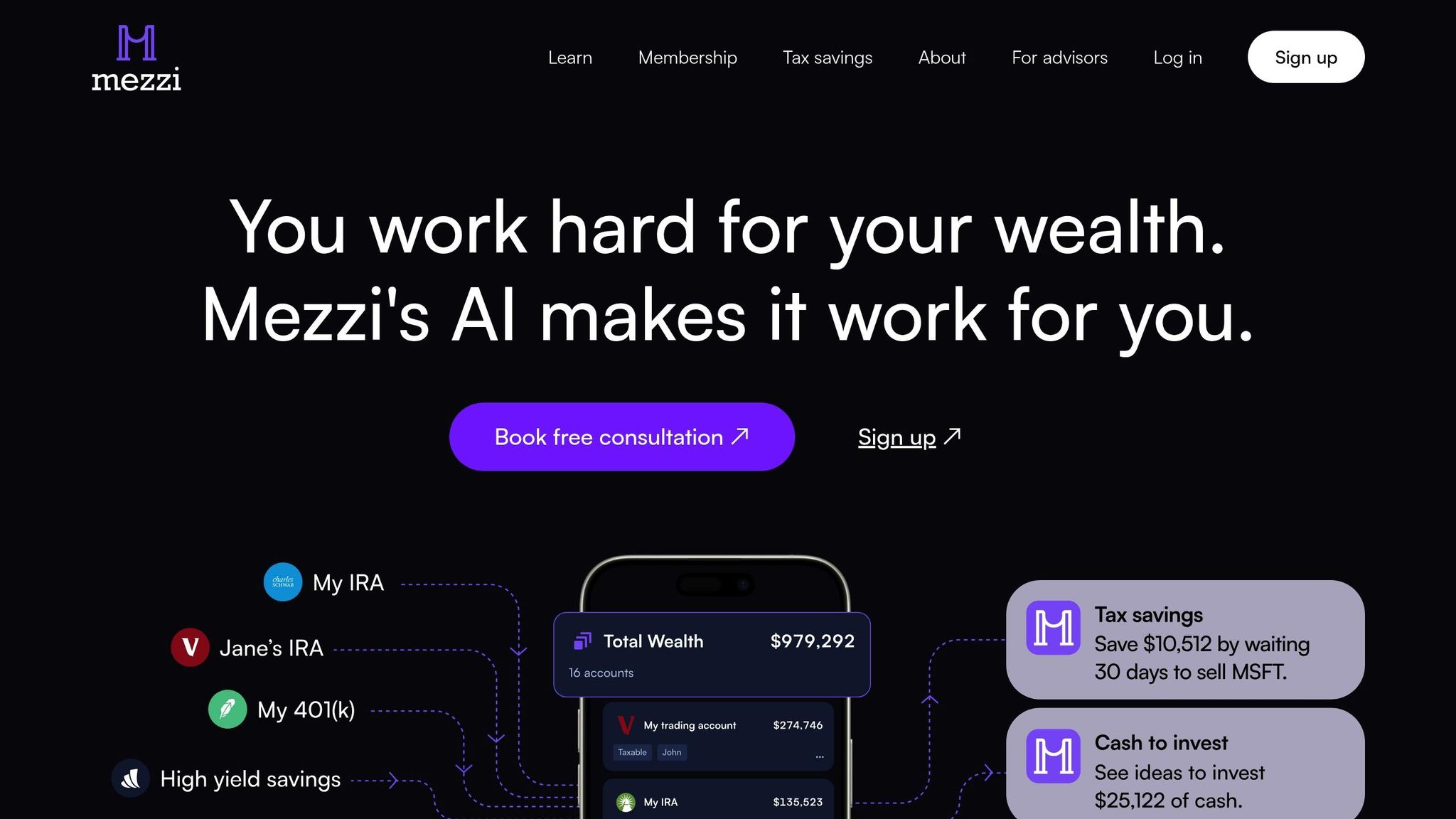
Mezzi is taking wealth management to the next level with its dynamic AI-driven rebalancing tools. By combining advanced technology with user-friendly features, the platform simplifies portfolio management for self-directed investors. It offers financial insights that were once the domain of costly advisors, making wealth optimization accessible to a broader audience.
Key Features of Mezzi
Mezzi brings all your financial accounts together into one streamlined view, providing actionable insights powered by AI. For example, the platform's X-Ray feature uncovers hidden stock exposures and portfolio concentrations. This tool highlights overlaps and potential risks from unintended concentration, helping you make smarter rebalancing decisions.
Another standout feature is its real-time tax alerts, which help you avoid common errors like wash sales while identifying tax-saving opportunities. Additionally, the platform includes tax forecasting tools that assist in planning for future obligations. This turns tax planning into a proactive strategy, aligning your investments with long-term financial goals. Mezzi's tools are designed to deliver immediate, actionable intelligence that simplifies decision-making.
Real-Time Financial Intelligence
Mezzi's AI doesn't just provide static data - it actively monitors your financial situation and market trends. It flags potential issues and suggests opportunities tailored to your portfolio. For instance, the Financial Calculator estimates retirement savings by factoring in your current portfolio value, annual contributions, expected returns, and asset manager fees - features typically found in high-end financial software.
The platform also tracks market conditions and portfolio performance in real time. By offering risk alerts and adaptive performance analysis, it enables you to make dynamic rebalancing decisions based on current market realities, rather than relying on outdated, calendar-based methods. These capabilities ensure your strategies stay aligned with modern wealth-building approaches.
Cost and Time Savings for Investors
Mezzi doesn't just simplify portfolio management - it also saves you money and time. By eliminating traditional advisor fees, investors could potentially save over $1 million across 30 years. The platform offers two pricing options: a Free plan with essential tools and account aggregation, and a Core membership for $299 per year, which unlocks advanced AI-driven features.
Time savings are equally impressive. Tasks like tracking wash sales, monitoring hidden exposures, or calculating tax implications are automated, freeing you from these time-consuming processes. Using secure data aggregators like Plaid and Finicity, Mezzi ensures your data remains private. Features such as Apple login for anonymized email and an ad-free experience underscore its strong focus on user privacy.
The Future of Wealth Growth with AI
The rise of AI-powered dynamic rebalancing is reshaping how we think about growing wealth. Instead of relying on fixed schedules, this approach adapts in real time to market changes. According to recent research, 65% of asset managers are expected to adopt AI by 2024, and with a 12% annual growth rate, a $100,000 portfolio could potentially grow to $383,375 over 12 years.
What's even more exciting is how AI is leveling the playing field for self-directed investors. Today, investors managing their own portfolios can access tools that were once reserved for professionals. These tools create personalized portfolios tailored to individual financial goals, investment habits, and even ESG (Environmental, Social, and Governance) preferences. Mezzi's platform is a prime example, combining real-time insights with customized strategies to empower these investors.
At its core, Mezzi is designed to bring advanced financial intelligence to self-directed investors. Its features include active market monitoring, identifying tax-saving opportunities, and delivering actionable insights in real time. By removing traditional advisor fees and offering professional-grade tools, Mezzi is making high-level wealth management more accessible than ever.
As AI continues to evolve, dynamic rebalancing is becoming even more sophisticated, offering real-time, tailored portfolio management. With further advancements on the horizon, investors can look forward to a new wave of tools that will push the boundaries of wealth growth and dynamic management.
FAQs
How does AI-powered dynamic rebalancing help grow my investments while managing risk?
AI-powered dynamic rebalancing takes the guesswork out of managing your investments. It works by constantly monitoring your portfolio and making adjustments to ensure it stays in sync with your financial goals and the ever-changing market landscape. By reallocating funds from overvalued or underperforming assets to those with stronger growth potential, it helps reduce risk and keeps your portfolio on track.
This process leverages real-time data and predictive analytics to keep your investments optimized for better returns, all while keeping tax implications in check. The result? A more balanced portfolio that supports your long-term growth objectives and gives you confidence in your financial strategy.
How does AI-powered dynamic rebalancing adapt to market changes in real time?
AI-powered dynamic rebalancing uses cutting-edge tools like machine learning, predictive analytics, and reinforcement learning to respond to market changes as they happen. These technologies sift through massive amounts of financial data, predict asset performance, and identify the best rebalancing strategies to suit current market conditions.
Take reinforcement learning, for instance - it allows systems to get smarter by learning from previous decisions. Predictive analytics, on the other hand, spots market trends early, enabling proactive portfolio adjustments. When combined, these approaches help keep your investments on track, maintaining the right asset mix and supporting long-term wealth growth.
How does Mezzi protect my financial data while offering advanced AI-driven features?
Mezzi takes the protection of your financial data seriously, employing strong encryption, multi-factor authentication, and real-time threat monitoring to safeguard your information against cyber risks and unauthorized access.
On top of that, Mezzi regularly upgrades its systems to align with top-tier security protocols, so you can confidently use its AI-powered tools to manage and grow your wealth.
Related Blog Posts
Table of Contents
Book Free Consultation
Walk through Mezzi with our team, review your current situation, and ask any questions you may have.