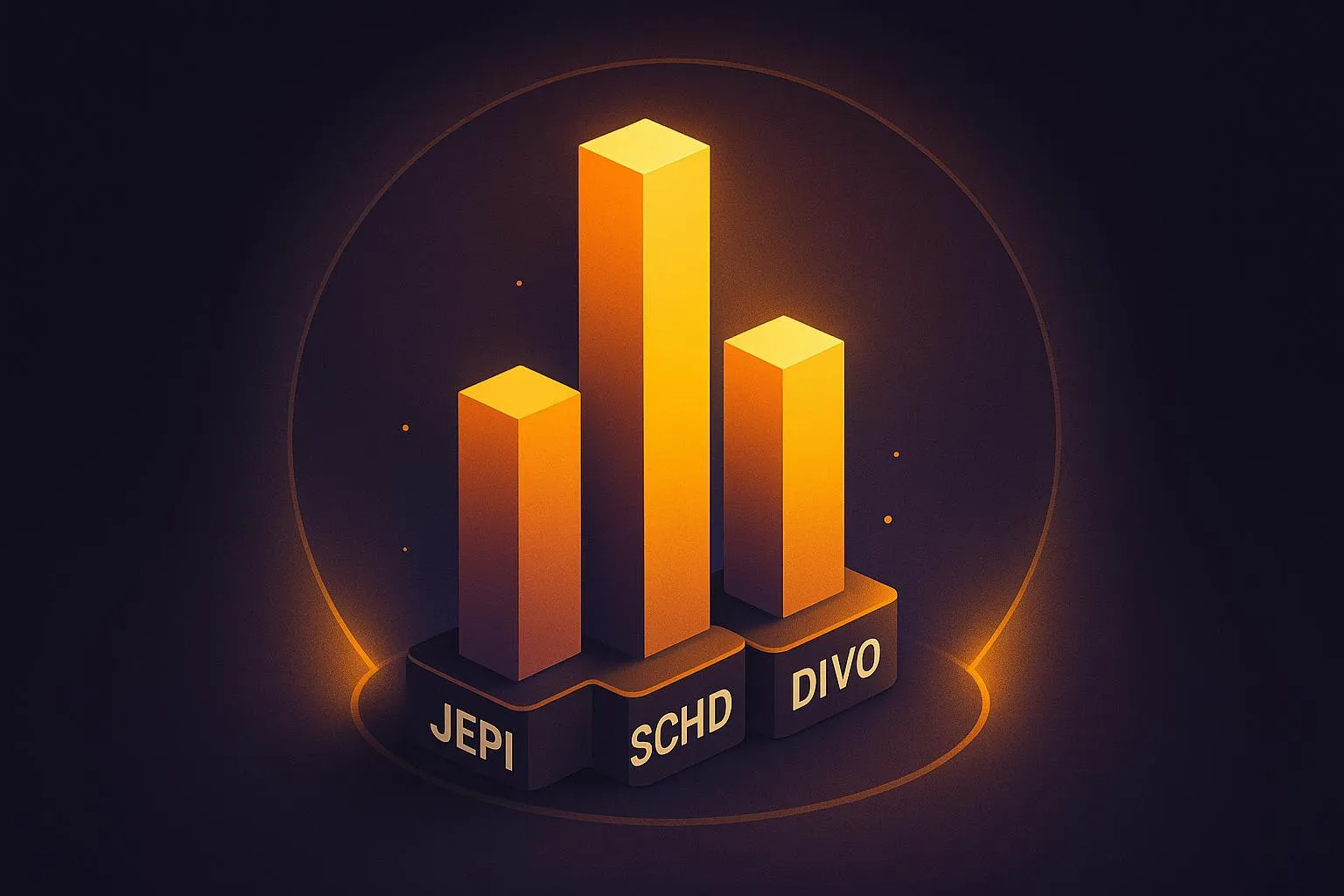
When building an income portfolio, balancing yield and risk is key. JEPI, SCHD, and DIVO are three ETFs often considered for this purpose, each offering distinct strategies and outcomes. Here's a quick breakdown:
- JEPI (JPMorgan Equity Premium Income ETF): Offers the highest yield at 8.40%, combining S&P 500 stocks with covered call strategies. It has low volatility (1.94%), but its growth potential is capped due to its options-based approach.
- SCHD (Schwab US Dividend Equity ETF): Focuses on established, dividend-paying companies, delivering a 3.88% yield. It has higher volatility (13.95%) but provides consistent dividend growth over time.
- DIVO (Amplify CWP Enhanced Dividend Income ETF): Blends dividend-paying stocks with covered call strategies, offering a 4.59% yield and moderate volatility (2.04%). It strikes a balance between income and growth but comes with higher fees due to active management.
Each ETF caters to different income goals. JEPI prioritizes current income, SCHD emphasizes steady dividend growth, and DIVO offers a middle-ground approach. Choosing the right one depends on your priorities: high yield, stability, or a mix of both.
Quick Comparison
| Factor | JEPI | SCHD | DIVO |
|---|---|---|---|
| Yield | 8.40% | 3.88% | 4.59% |
| Volatility | Low (1.94%) | High (13.95%) | Moderate (2.04%) |
| Strategy | Covered calls + stocks | Dividend-paying stocks | Dividend + covered calls |
| Expense Ratio | Higher | Low | Higher |
| Growth Potential | Limited | Higher | Moderate |
For a tailored portfolio, blending these ETFs can help balance income and risk effectively.
SCHD vs JEPI vs DIVO vs VTI… Who Wins?
1. JEPI (JPMorgan Equity Premium Income ETF)
JEPI stands out for its combination of high yield and low volatility, making it a popular choice for income-focused investors. Designed to deliver steady monthly payouts while managing risk, JEPI blends dividend income with options premiums. Let’s take a closer look at what defines this fund.
Yield
JEPI is built to provide consistent monthly cash flow through a high-yield distribution model. By generating income from both traditional dividends and options premiums, the fund maintains its payout levels even when dividends alone might falter.
Risk Profile
To manage risk, JEPI uses a covered call strategy and equity-linked notes as a buffer against market downturns. While this approach may cap upside potential during strong market rallies, it suits conservative investors who prioritize steady income and capital protection over high growth.
Expense Ratio
JEPI’s active management and options strategies come with higher fees compared to passive dividend ETFs. However, these costs are considered reasonable given the fund’s dual focus on income generation and risk mitigation, which requires a more hands-on approach.
Portfolio Composition
JEPI’s portfolio is a mix of large-cap U.S. equities and equity-linked notes, offering a diversified exposure across sectors like technology, healthcare, and financials. Writing call options on a portion of its holdings allows the fund to generate additional premium income while providing some downside protection.
This combination of dividend-paying stocks and strategic options creates a balance between income potential and risk management, appealing to investors looking for steady returns with a moderated risk profile.
2. SCHD (Schwab US Dividend Equity ETF)

SCHD offers a straightforward take on dividend investing. Unlike JEPI, which blends income strategies, SCHD zeroes in on dividend payments. It’s a passively managed fund tracking the Dow Jones U.S. Dividend 100 Index, focusing on high-quality U.S. companies with strong dividend histories - without relying on options strategies or active management layers.
Yield
SCHD generates income solely through traditional dividend payments from its holdings. The companies in the fund are carefully chosen for their consistent dividend-paying track records and solid financial health. This focus on reliable, dividend-paying stocks creates a steady income stream over time, making it an appealing option for those prioritizing dividends.
Risk Profile
SCHD comes with higher volatility compared to actively managed income funds. Its daily standard deviation is 16.15%, with a 1-year volatility of 13.95% and a 3-year volatility of 16.01%. These numbers highlight the fund's susceptibility to price swings, especially during market downturns.
The fund’s maximum drawdown since inception reached -33.37%, showcasing how even traditional dividend strategies can face steep declines during market corrections. Currently, SCHD is experiencing a -6.37% drawdown, reflecting recent market challenges. Its Sharpe ratio of -0.19 suggests that, in recent times, the risks taken by investors haven’t been met with adequate returns.
The fund’s exposure to cyclical sectors like energy and industrials often leads to sharper declines during economic uncertainty. However, its allocation to consumer defensive sectors provides some stability during economic slowdowns. This balance highlights the trade-off of pursuing a pure dividend strategy, which can be more volatile compared to conservative income-focused funds.
Expense Ratio
One of SCHD’s standout features is its low expense ratio. As a passively managed fund, it avoids the higher costs tied to active management or complex strategies. Over time, these lower fees can make a big difference, especially for long-term investors looking to maximize their returns.
Portfolio Composition
SCHD’s portfolio is made up entirely of large-cap U.S. dividend stocks, selected based on their consistent dividend payouts and strong fundamentals. The fund spans multiple sectors, including consumer defensive, energy, and industrials, offering a mix of income generation and some protection against economic cycles.
With a 14-year track record since its launch on October 20, 2011, SCHD has shown the benefits of dividend reinvestment and compounding over time. Its focus on well-established companies makes it a good choice for investors who are willing to endure market ups and downs in exchange for long-term growth and steady income. This approach suits those prioritizing sustained growth over immediate income stability.
sbb-itb-e429e5c
3. DIVO (Amplify CWP Enhanced Dividend Income ETF)
DIVO employs a hybrid strategy to generate income, blending traditional dividend-paying stocks with covered call writing. This actively managed fund aims to provide higher income while maintaining exposure to dividend growth, striking a balance between income generation and potential capital appreciation.
Yield
DIVO generates income through two main sources: dividends from its stock holdings and premiums earned from covered call writing. This combination results in a higher yield compared to traditional dividend ETFs, while maintaining a more conservative approach than funds heavily reliant on options strategies.
By selling call options on a portion of its equity holdings, DIVO boosts income but may limit gains during strong market rallies. This trade-off prioritizes current income over capital gains in bullish markets.
The dividend component emphasizes companies with sustainable payout ratios and growth potential rather than chasing the highest yields. This selective approach helps stabilize income and offers some protection against dividend cuts during economic downturns.
This dual-income strategy directly influences DIVO's risk and return profile.
Risk Profile
DIVO's risk level falls between equity and bond funds. The premiums from covered call writing provide a cushion during market downturns but do not eliminate exposure to broader market risks.
The covered call strategy acts as a partial hedge during declining markets, as the collected premiums can offset some losses. However, this protection has limits and does not shield the fund from significant losses during major market corrections. For example, during the March 2020 market selloff, DIVO experienced steep declines similar to other equity-heavy funds, though the options income helped soften the blow.
The fund's sector diversification - spanning technology, healthcare, financials, and consumer sectors - reduces concentration risk. However, its equity-heavy allocation means it remains vulnerable to broader market trends and economic cycles. Additionally, as an actively managed fund, DIVO introduces manager risk, as its success depends on the portfolio team's ability to effectively time covered call writing and select stocks.
Expense Ratio
Being an actively managed fund, DIVO has higher fees than passive alternatives like SCHD. These costs reflect the expenses of active portfolio management, implementing options strategies, and conducting ongoing research. Over time, these fees can erode returns, especially in periods when the fund's active strategy doesn't outperform simpler approaches.
For long-term success, DIVO must consistently generate income that exceeds its expense ratio. While the active management adds flexibility and potential for higher income, it also directly affects net returns.
Portfolio Composition
DIVO's portfolio typically holds 25-30 large-cap U.S. stocks, chosen for their ability to pay dividends and their options liquidity. This concentrated approach allows for targeted covered call writing while still maintaining sector diversification.
The fund invests in established companies like Microsoft, Apple, and Johnson & Johnson - firms known for strong balance sheets and predictable cash flows. This focus on high-quality companies supports the dividend component and provides reliable underlying assets for its options strategies.
The management team adjusts the covered call overlay based on market conditions, increasing premiums during volatile periods and scaling back during strong uptrends.
Since its inception in December 2014, DIVO has shown how a balanced income strategy can appeal to investors seeking higher yields than traditional dividend funds, without delving into the complexities of pure options strategies.
Advantages and Drawbacks
Balancing yield and risk is essential when crafting an income-focused portfolio. Below, we break down the strengths and limitations of JEPI, SCHD, and DIVO. The table highlights key factors to help you understand how each ETF’s structure impacts yield stability, market behavior, and expenses.
| Factor | JEPI | SCHD | DIVO |
|---|---|---|---|
| Primary Advantage | Boosts current income through an options overlay | Consistent dividend growth with low volatility | Combines income generation with moderate risk |
| Main Drawback | Limited potential for capital growth | Lower current yield compared to options-based strategies | Higher fees due to active management |
| Yield Stability | Variable, depending on options market conditions | Very stable and predictable | Moderately stable, supported by dual income sources |
| Market Volatility | Reduced by options-based strategies | Naturally low volatility | Moderate protection from covered calls |
| Fee Impact | Moderate expense ratio | Low fees, maximizing investor returns | Higher fees that could dampen long-term gains |
| Portfolio Concentration | Broadly diversified across sectors | Focused on quality, dividend-paying companies | Concentrated in 25–30 large-cap stocks |
JEPI stands out for its income-boosting strategy, using an options overlay to generate higher payouts. However, this approach limits capital growth potential when shares are called away. Additionally, its reliance on options markets introduces variability in income, making it less predictable than traditional dividend-focused funds.
SCHD focuses on stability, investing in high-quality companies with strong dividend growth histories. Its low fees and consistent payouts make it a solid choice for long-term income seekers. While it doesn’t offer the high yields of options-enhanced strategies, its steady performance and reliability appeal to those prioritizing stability over immediate returns.
DIVO takes a hybrid path, combining dividend-paying stocks with covered call strategies to enhance income while allowing for modest growth. This approach offers a middle ground but comes with higher fees due to active management. Its concentrated portfolio also introduces additional risk compared to more diversified funds.
Which ETF Works Best for Your Income Goals
Let’s break down how each ETF aligns with different income goals based on the strategies they employ.
JEPI focuses on generating higher current income by utilizing an options overlay strategy. This approach enhances payouts but comes with some variability, making it suitable for those prioritizing immediate income over consistency.
SCHD takes a more traditional route, emphasizing steady dividend growth with the added potential for capital appreciation. Its portfolio leans on established companies, making it an appealing choice for those seeking stability and a long-term income strategy.
DIVO strikes a balance between immediate income and moderate growth. By combining yield enhancement with traditional dividend strategies, it offers a middle-ground option. However, its active management approach may result in higher fees compared to passively managed funds.
For investors, blending these ETFs can be a practical way to tailor a portfolio to specific income goals and risk preferences.
When implementing your strategy, keep tax considerations in mind - such as how JEPI’s options income may be taxed differently than SCHD’s qualified dividends. Also, consider using dollar-cost averaging to manage market volatility as you build your position.
FAQs
How does JEPI’s covered call strategy impact its risk and return compared to dividend-focused ETFs like SCHD?
JEPI employs a covered call strategy to generate income by writing call options on its portfolio of S&P 500 stocks. This method creates a consistent monthly income stream and can help smooth out market swings, making it attractive to income-focused investors looking for a steadier ride.
That said, this strategy comes with a trade-off: it limits JEPI's ability to benefit from significant stock price increases, as gains are capped. On the other hand, dividend-focused ETFs like SCHD emphasize long-term growth by reinvesting dividends. While this approach may offer more growth potential, it also comes with a higher level of exposure to market ups and downs.
What tax considerations should I be aware of when investing in JEPI, SCHD, or DIVO?
The way income from JEPI, SCHD, and DIVO is taxed depends on how each fund structures its dividends. SCHD primarily pays out qualified dividends, which might be taxed at a lower rate depending on your income bracket. On the other hand, JEPI generates income through options strategies, and its distributions are typically taxed as ordinary income, often subject to a higher tax rate than qualified dividends.
If you're investing in a taxable account, understanding these tax differences can guide your choices. For those looking to reduce tax liability, SCHD’s qualified dividends could be a better fit. Meanwhile, JEPI’s income structure might work well in tax-advantaged accounts like IRAs or 401(k)s, where tax implications are deferred or reduced.
How can investors combine JEPI, SCHD, and DIVO to build a balanced income portfolio while managing risk?
Investors looking to build a balanced income portfolio can combine JEPI, SCHD, and DIVO, each offering unique strengths. JEPI stands out for its higher yield of 8.30%, though it comes with a slightly higher expense ratio of 0.35%, making it a solid choice for those prioritizing immediate income. On the other hand, SCHD provides a more modest yield of 3.77%, paired with a low expense ratio of 0.06%, offering stability and potential for long-term growth. DIVO offers a middle ground with a yield of 4.59% and an expense ratio of 0.55%, making it a good option for those seeking a balance between income and growth.
By spreading investments across these ETFs, investors can reduce overall risk. For instance, JEPI’s lower volatility (1.58%) compared to SCHD (3.74%) can help cushion the impact of market downturns. Deciding how to allocate funds among these ETFs depends on individual goals, risk tolerance, and investment time frame, ensuring a well-rounded and sustainable income strategy.
Related Blog Posts
Table of Contents
Book Free Consultation
Walk through Mezzi with our team, review your current situation, and ask any questions you may have.