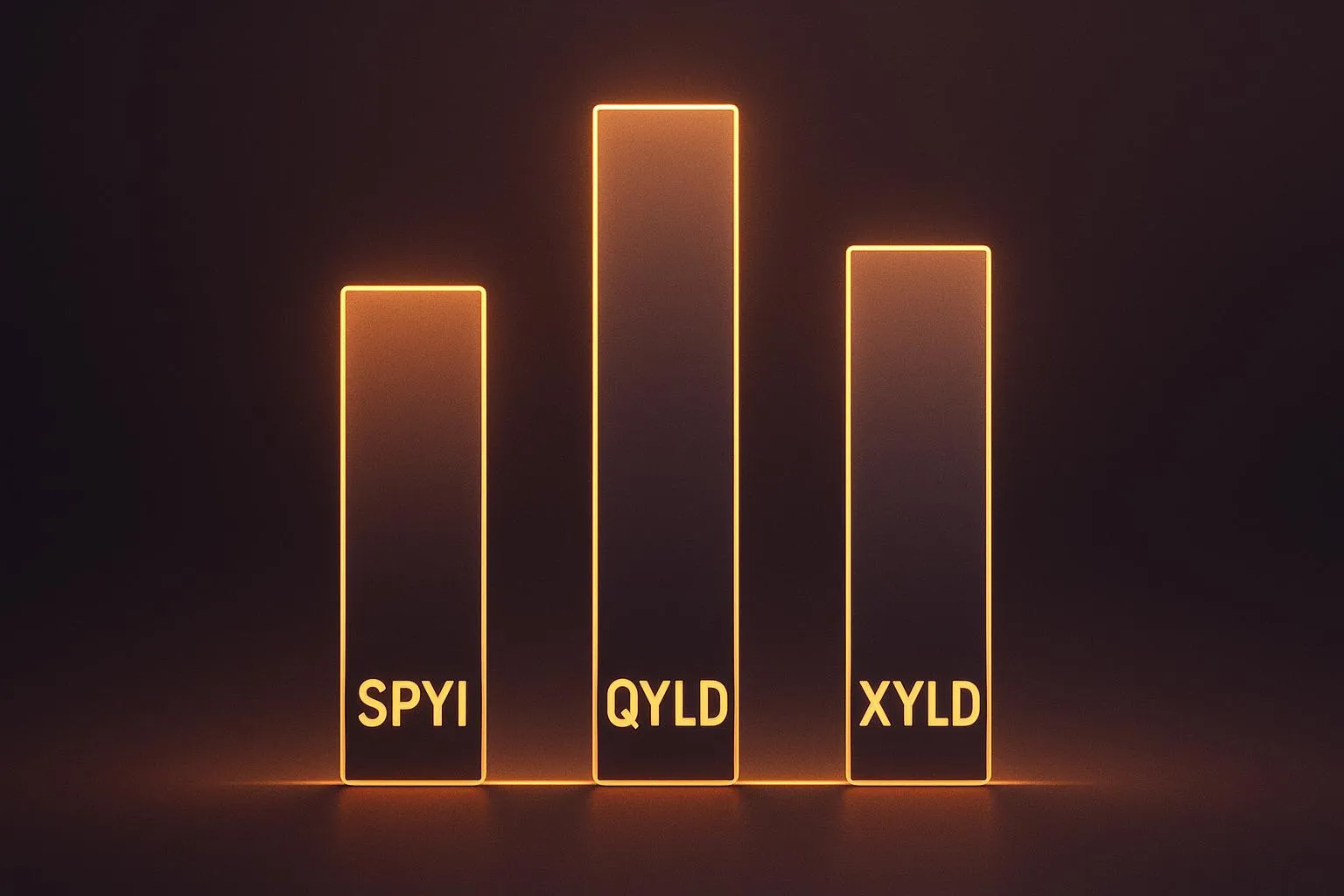
Looking for steady income from covered-call ETFs? SPYI, QYLD, and XYLD are top contenders, but they differ in yield, tax treatment, and long-term performance. Here's what you need to know:
- SPYI: Focuses on S&P 500 stocks with an emphasis on income and tax efficiency. Uses Section 1256 contracts for a favorable 60/40 tax split and offers active tax-loss harvesting. Higher expense ratio (0.68%) but strong for taxable accounts.
- QYLD: Targets the Nasdaq 100, providing high monthly payouts but less tax-efficient. Most distributions are taxed as ordinary income, and heavy reliance on return of capital (ROC) can erode NAV.
- XYLD: Also tied to the S&P 500, it balances income and diversification. Distributions are mostly taxed as ordinary income, with a 0.60% expense ratio. Less growth potential during bull markets.
Quick Comparison:
| Feature | SPYI | QYLD | XYLD |
|---|---|---|---|
| Expense Ratio | 0.68% | 0.60% | 0.60% |
| Index Focus | S&P 500 | Nasdaq 100 | S&P 500 |
| Tax Strategy | 60% long-term / 40% short-term | Mostly ordinary income | Mostly ordinary income |
| Return of Capital | Yes (98%) | Yes (98%) | Variable |
| Upside Potential | Limited in bull markets | Limited in bull markets | Limited in bull markets |
Key Takeaway: SPYI stands out for its tax efficiency and income focus, making it ideal for taxable accounts. QYLD and XYLD offer high yields but may face higher tax burdens and limited growth during market rallies.
Pick the ETF that aligns with your income needs and tax situation.
SPYI: NEOS S&P 500 High Income ETF
SPYI Strategy and Yield
SPYI takes a covered-call approach by investing in a broad mix of S&P 500 stocks while selling call options to generate monthly income. During periods of heightened market volatility, the fund increases its option-selling activity to take advantage of higher premiums. Let’s dive into how this strategy impacts performance and tax considerations.
Performance and Tax Treatment
For taxable investors, tax considerations are a critical factor. A portion of SPYI's monthly distributions may be classified as a return of capital. This classification can defer immediate tax liabilities by reducing the investment's cost basis, with taxes deferred until the shares are sold. While this income-focused strategy can provide stability during challenging market conditions, it may come at the cost of limiting upside potential during strong market rallies compared to a traditional index fund. Additionally, the active management required for the covered-call strategy typically results in higher operating expenses than those associated with passive funds.
Pros and Cons for Taxable Accounts
SPYI has several benefits for income-oriented investors holding taxable accounts. Its strategy generates regular monthly income and relies on the stability of large-cap S&P 500 stocks. The potential tax deferral from return of capital distributions can also be advantageous for investors looking to manage taxable portfolios efficiently.
However, there are trade-offs. The focus on generating income can limit gains during bull markets, as shares may be called away at preset strike prices. Tracking return of capital distributions adds a layer of complexity for investors. Additionally, the higher fees linked to active management might reduce long-term returns for those prioritizing capital growth over consistent income.
QYLD: Global X NASDAQ 100 Covered Call ETF
QYLD Strategy and Yield
QYLD employs a systematic covered-call strategy on NASDAQ 100 stocks, focusing on tech-heavy companies like Apple, Microsoft, and Amazon - stocks known for their higher volatility. Each month, the fund sells call options on the last trading day, setting a strike price based on the index's value at that time. This structured approach generates consistent monthly income but comes with a trade-off: limited upside potential during robust bull markets. Let’s delve into how this strategy impacts performance and tax considerations.
Performance and Tax Treatment
QYLD's tax structure can be a hurdle for investors with taxable accounts. Unlike the underlying stocks, which often qualify for lower tax rates on dividends, QYLD's distributions are typically taxed as ordinary income. This happens because the fund’s use of offsetting options disqualifies the dividends from receiving preferential tax treatment.
As of September 2025, QYLD’s Tax Cost Ratio stands at 3.57% year-to-date, 5.06% over the past year (as of September 2024), and 4.84% over three years, with an average of 4.40% since its inception.
The classification of QYLD’s distributions varies. While some distributions may be categorized as a return of capital (ROC) - delaying taxes until shares are sold - this isn’t guaranteed. Historical data shows that, at times, 100% of the distributions have been classified as ordinary income. Moreover, taxes apply to distributions regardless of whether they are reinvested.
Pros and Cons for Taxable Accounts
QYLD offers both benefits and drawbacks for investors in taxable accounts. On the plus side, it provides reliable monthly income from a diverse portfolio of large-cap technology stocks, giving investors exposure to the tech sector’s growth while maintaining a steady cash flow. Additionally, when distributions are classified as ROC, taxes can be deferred, although this classification isn’t consistent.
On the downside, the fund’s tax treatment is less efficient. Its relatively high Tax Cost Ratio can erode after-tax returns compared to other strategies. QYLD also doesn’t lend itself well to tax-loss harvesting, as finding a comparable alternative fund is difficult.
Another potential drawback is the capped upside during strong bull markets. The covered-call strategy means shares may be called away if the NASDAQ 100 surpasses the strike prices set by the fund. For investors who don’t rely on regular monthly income, a more tax-efficient approach might involve selling shares as needed, allowing the remaining capital to stay invested and grow over time.
XYLD: Global X S&P 500 Covered Call ETF
XYLD Strategy and Yield
The Global X S&P 500 Covered Call ETF (XYLD) combines investments in S&P 500 stocks with a strategy of selling monthly call options. Since launching on June 21, 2013, the fund has grown to manage $3.02 billion in net assets as of October 14, 2025. It currently offers a trailing 12-month distribution of 13.30% and an annual dividend yield of 12.93% as of October 2025.
While the high yield is appealing, it comes with a trade-off. When the S&P 500 experiences significant gains, the call options limit XYLD's ability to fully capitalize on the rally. This is reflected in the fund's beta of 0.44, which indicates reduced volatility compared to the broader market. Now, let’s take a closer look at its performance and tax considerations.
Performance and Tax Treatment
XYLD’s performance highlights the balance between generating income and achieving total return growth. Over the past year, the fund delivered a 7.41% total return and has achieved an average annual return of 7.64% since its inception. However, its year-to-date daily total return of 1.89% as of October 13, 2025, alongside a payout ratio of 362.03%, illustrates how covered-call strategies can lag during strong market rallies.
From a tax standpoint, XYLD’s distributions are taxed as ordinary income rather than benefiting from the lower rates applied to qualified dividends. Additionally, the fund’s 0.60% expense ratio reflects the costs tied to its active options strategy. These factors emphasize the trade-offs involved in using covered-call strategies, particularly for investors with taxable accounts.
Pros and Cons for Taxable Accounts
For taxable investors, there are both advantages and drawbacks to consider. On the plus side, XYLD provides consistent monthly payouts and reduced volatility (beta of 0.44) through its diversified S&P 500 portfolio. Its growing popularity has also bolstered its scale and liquidity, making it a prominent choice among covered-call ETFs.
However, the tax treatment of its distributions as ordinary income can weigh on after-tax returns, particularly for those in higher tax brackets. When combined with the 0.60% expense ratio, these factors raise questions about whether the high yields justify the potential underperformance in strong bull markets.
Side-by-Side Comparison: Income, Performance, and Tax Impact
Comparison Table: Main Metrics
When looking at these three covered-call ETFs for taxable accounts, the table below highlights some key differences in their core metrics:
| Feature | SPYI | QYLD | XYLD |
|---|---|---|---|
| Expense Ratio | 0.68% | 0.60% | 0.60% |
| Primary Tax Strategy | Section 1256 contracts + active tax-loss harvesting | Heavy Return of Capital (ROC) | Return of Capital (ROC) |
| ROC Percentage (2025) | 98% of distributions | 98% of distributions | Variable by year |
| Tax Treatment of Gains | 60% long-term / 40% short-term | Generally short-term capital gains | Generally short-term capital gains |
| Tax-Loss Harvesting | Active implementation | Not available | Not available |
These metrics provide a foundation for understanding how each ETF handles taxes and how that affects after-tax returns.
Tradeoffs for Taxable Account Holders
The table above emphasizes the tax strategies and yield differences that significantly impact investors in taxable accounts. SPYI stands out for its use of Section 1256 contracts, which apply a 60% long-term and 40% short-term tax split, regardless of how long the investment is held. This structure can reduce the effective tax rate on short-term option trades compared to the ordinary income tax rates that typically apply to covered-call strategies.
On the other hand, QYLD and XYLD are less tax-efficient for taxable accounts. Both generate option income that is usually taxed as short-term capital gains. Additionally, dividends from their underlying stocks often don’t qualify for lower, qualified dividend rates due to the offsetting options positions. However, these funds do emphasize return of capital (ROC), which defers taxes on current distributions.
While tax deferral through ROC can be appealing, it comes with a downside. For example, QYLD's heavy reliance on ROC has been linked to a 3.72% annual NAV erosion since 2013. In contrast, SPYI uses active tax-loss harvesting to help offset potential erosion by capturing losses that can reduce future tax liabilities.
Although SPYI has a slightly higher expense ratio at 0.68% compared to QYLD and XYLD at 0.60%, its tax advantages - thanks to Section 1256 contracts and tax-loss harvesting - make it more appealing for after-tax returns. These strategies provide more consistent tax efficiency, making SPYI a strong contender for taxable accounts. Up next, we’ll dive into how Mezzi incorporates these benefits to optimize outcomes for investors.
sbb-itb-e429e5c
How Mezzi Optimizes Covered-Call Strategies in Taxable Accounts

Tax Optimization Features
Mezzi's platform is designed to help investors navigate the complexities of tax efficiency across their accounts. It goes beyond simple tax tracking by identifying opportunities to lower tax liabilities and enhance after-tax returns.
One standout feature is the wash sale avoidance tool, which helps investors manage covered-call ETFs across multiple accounts. By keeping an eye on your connected accounts, Mezzi flags potential wash sale risks, helping you steer clear of violations that could result in costly tax consequences. This proactive approach not only reduces errors but also helps you save on taxes and fees, laying the groundwork for more in-depth portfolio analysis.
ETF Selection Insights
Mezzi's X-Ray feature uncovers hidden exposures and overlaps within your portfolio. When assessing covered-call ETFs, this tool shows how each addition aligns with your overall investment strategy, pinpointing areas of concentration or accidental duplication.
By pulling data from all your accounts, Mezzi delivers tailored recommendations to help you seamlessly incorporate covered-call strategies into your portfolio. The platform also includes a Financial Calculator that estimates the long-term impact of fees, offering a clearer picture of how management costs could influence your returns. These insights directly support strategies aimed at boosting after-tax performance.
Maximizing After-Tax Returns with Mezzi
Using its advanced tax tools and portfolio insights, Mezzi enables investors to fine-tune their covered-call strategies. Real-time alerts ensure you’re ready to make adjustments as market conditions shift, whether that means rebalancing or modifying positions.
Additionally, Mezzi offers an unlimited AI chat feature that lets you explore various scenarios and receive customized insights based on your portfolio. This interactive tool allows you to ask detailed questions and better understand how different approaches might impact your after-tax results.
For those opting for Mezzi's White Glove Membership, the platform takes personalization a step further with unlimited AI coaching calls. This service combines automated insights with one-on-one guidance, helping you craft tax-efficient strategies tailored to your unique goals.
Conclusion
Main Takeaways
Choosing the right covered-call ETF depends on what matters most to you - whether it’s income, tax considerations, or market exposure. Each option comes with its own set of tradeoffs that can affect your after-tax returns.
- SPYI appeals to those prioritizing higher income potential, thanks to its advanced options strategies.
- QYLD delivers steady monthly distributions while offering NASDAQ 100 exposure, though it may underperform in strong bull markets.
- XYLD strikes a balance with S&P 500 diversification and moderate yields, potentially offering better tax efficiency for long-term investors.
Tax treatment plays a significant role here. Most distributions from covered-call ETFs are taxed as ordinary income rather than qualified dividends, so planning is crucial. If these ETFs make up a large portion of your portfolio, think carefully about your tax bracket and goals. For high-income earners, the ordinary income taxation could reduce the appeal compared to growth investments that focus on capital gains. On the other hand, if you're in a lower tax bracket or need consistent income, the higher yields may outweigh the tax implications.
Final Thoughts on Optimization
Effectively managing covered-call ETFs requires a thoughtful approach to balancing yield and tax costs. Tax rules, wash sales, and position adjustments add layers of complexity, so staying informed and disciplined is key. Aligning these strategies with your broader financial goals will help you get the most out of your investments while keeping after-tax returns in focus.
SPYI: The Covered Call ETF That Gets It Right
FAQs
What are the tax advantages of SPYI's Section 1256 contracts compared to the tax treatment of QYLD and XYLD in taxable accounts?
SPYI leverages Section 1256 contracts, which come with a tax advantage: 60% of gains are treated as long-term capital gains, and 40% as short-term capital gains, no matter how long the investment is held. This mixed tax treatment can lead to reduced overall taxes for investors in taxable accounts, especially when compared to the fully short-term capital gains treatment that typically applies to distributions from QYLD and XYLD.
For investors in higher tax brackets, this structure can make SPYI a more tax-efficient option, potentially boosting after-tax returns compared to other covered-call ETFs.
What are the risks and benefits of investing in covered-call ETFs like SPYI, QYLD, and XYLD in different market environments?
Covered-call ETFs like SPYI, QYLD, and XYLD come with distinct tradeoffs that hinge on market conditions. These funds generate income by selling call options, creating a steady cash flow, but they also limit how much you can benefit from market gains.
In times of market volatility, these ETFs tend to deliver higher income since option premiums rise during periods of uncertainty. That said, their payouts can be unpredictable, sometimes dropping by 30% to 50% in a single year. During bull markets, their performance often lags behind the underlying index because of the capped upside. On the flip side, in bear markets, the income from call premiums can soften the blow of losses, offering a degree of downside protection.
Grasping these nuances is key to setting realistic expectations and determining if these ETFs fit your investment strategy. This is especially critical in taxable accounts, where income and tax efficiency can significantly impact your returns.
How does return of capital (ROC) affect the net asset value (NAV) and long-term performance of covered-call ETFs?
Return of capital (ROC) in covered-call ETFs plays a key role in shaping their net asset value (NAV) and overall long-term performance. Essentially, ROC lowers an investor's cost basis, which can delay tax obligations until the investment is sold. While this tax deferral can be appealing, it comes with a downside - ROC often involves distributing part of the fund's principal, which can gradually decrease the NAV over time.
For investors in taxable accounts, ROC can boost after-tax income, offering a short-term benefit. However, it also means that some distributions are a return of the original investment rather than actual profits. This dynamic can limit the fund's potential for growth. As a result, investors must carefully balance their need for income with the potential impact on long-term value before committing to these ETFs.
Related Blog Posts
Table of Contents
Book Free Consultation
Walk through Mezzi with our team, review your current situation, and ask any questions you may have.