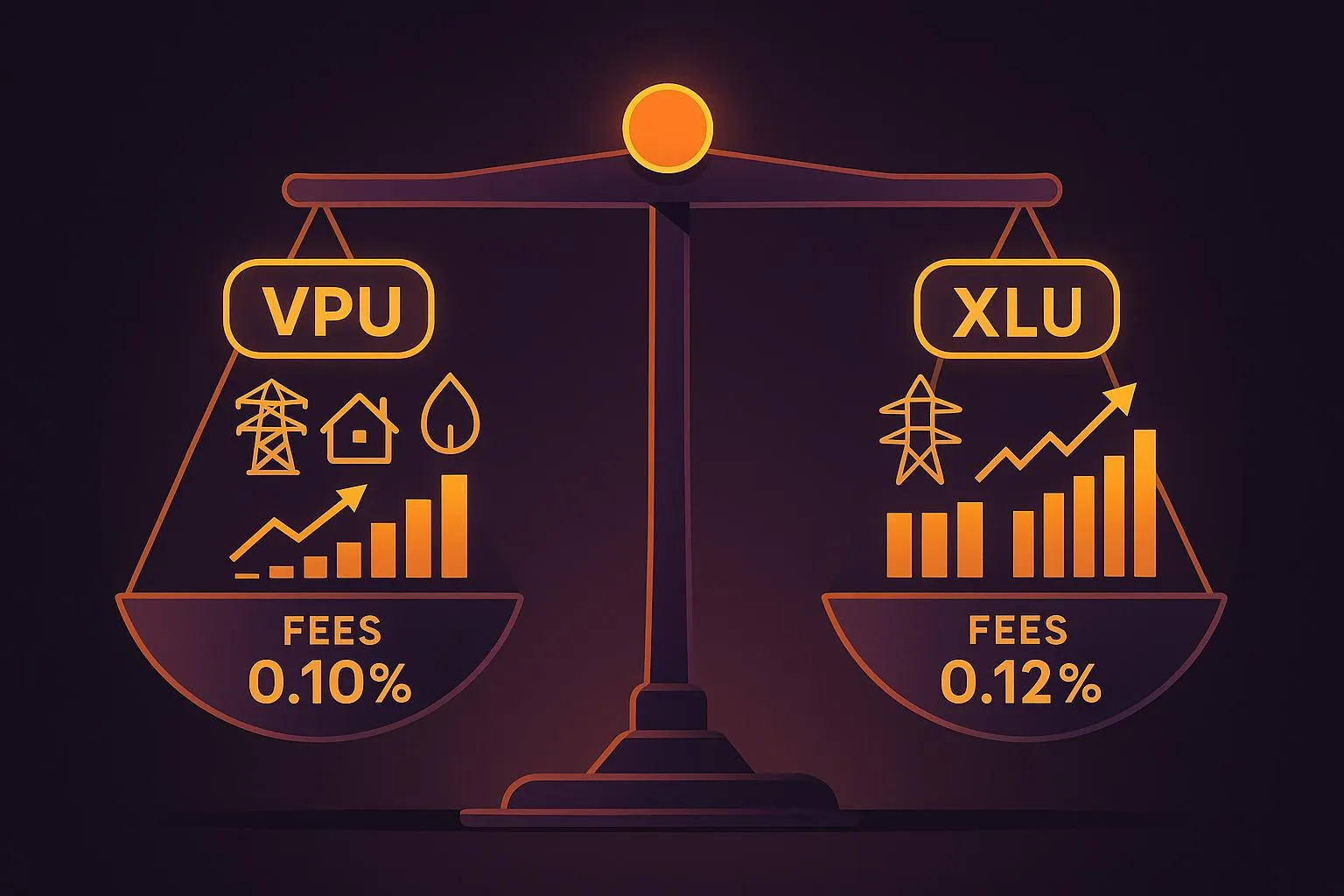
If you're comparing Vanguard Utilities ETF (VPU) and Utilities Select Sector SPDR Fund (XLU), here's what you need to know:
- Dividend Yield: XLU offers a higher current yield, focusing on large, established utility companies. VPU’s yield is slightly lower due to its broader mix of large and small companies.
- Dividend Growth: VPU has stronger dividend growth potential, thanks to its inclusion of utilities investing in modernization and renewable energy.
- Fees: XLU has a slight edge with a lower expense ratio (0.09% vs. VPU’s 0.10%). Over time, this can lead to small cost savings.
- Diversification & Risk: VPU holds 70 stocks, spreading risk more evenly. XLU holds only 33 stocks, making it more concentrated and reliant on a few key companies.
Quick Comparison Table
| Criteria | VPU | XLU |
|---|---|---|
| Dividend Yield | Lower | Higher |
| Dividend Growth | Higher Potential | Stable |
| Expense Ratio | 0.10% | 0.09% |
| Number of Holdings | 70 | 33 |
| Top 15 Holdings Weight | 65.32% | 72.74% |
| Sector Purity | 97.66% in Utilities | 99.81% in Utilities |
Summary: Choose XLU for higher immediate income and a focused strategy. Opt for VPU if you prefer long-term growth, lower concentration risk, and broader sector exposure.
WHICH UTILITY ETF AM I BUYING? VPU, XLU, FUTY OR IDU! WHICH IS BETTER?
Dividend Yield and Growth Comparison
Dividend yield and growth are key factors shaping income strategies in utilities ETFs. Both VPU and XLU have a solid history of paying dividends, but their approaches to generating income set them apart. Let’s dive into how their current yields and long-term growth stack up.
Current Dividend Yields
At present, XLU boasts a higher dividend yield compared to VPU. This stems from XLU’s more focused strategy, which leans heavily on larger, well-established utilities companies known for their dependable dividend payouts. On the other hand, VPU’s broader diversification - spanning a mix of both large and smaller utilities - results in a more balanced, albeit slightly lower, yield.
Historical Dividend Growth Rates
When it comes to dividend growth, VPU appears to have the edge. Its diverse portfolio includes utilities investing in modernization and renewable energy initiatives, driving potential for higher dividend growth over time. Meanwhile, XLU’s concentration on mature, large-cap utilities emphasizes stability and consistent payouts rather than rapid growth.
Ultimately, the decision comes down to your investment priorities: if you’re seeking higher immediate income, XLU might be the better fit. But if long-term growth in dividend income is your goal, VPU could be the stronger choice.
Expense Ratios and Fees
Even small differences in fees can add up significantly over time. Let’s break down how VPU and XLU stack up when it comes to costs.
Expense Ratios Comparison
When it comes to expense ratios, XLU edges out VPU with a slightly lower cost. XLU charges an expense ratio of 0.09%, while VPU comes in at 0.10%. While the difference might seem negligible, it does add up over the years. For every $10,000 invested:
- VPU costs about $10 annually.
- XLU costs about $9 annually.
Here’s a quick snapshot:
| ETF | Expense Ratio | Annual Cost on $10,000 | Annual Cost on $100,000 |
|---|---|---|---|
| VPU | 0.10% | $10 | $100 |
| XLU | 0.09% | $9 | $90 |
While a $1 difference per $10,000 might not feel like much, over decades, it can lead to noticeable savings. That said, fees alone shouldn’t dictate your choice. Other costs and factors can also impact your overall returns.
Other Associated Costs
Both ETFs are highly liquid, with narrow bid-ask spreads. However, XLU’s longer history and larger asset base give it a slight advantage in liquidity, making it easier to trade efficiently.
Another key factor is tax efficiency. Both funds benefit from the tax-friendly structure of ETFs, which use in-kind creation and redemption processes to keep capital gains distributions minimal.
Lastly, trading costs are unlikely to be a concern. With the rise of commission-free trading, most brokers allow you to buy and sell these ETFs without extra fees.
sbb-itb-e429e5c
Holdings and Concentration Analysis
Understanding the number of companies an ETF holds and how it allocates its investments can significantly influence your portfolio's risk profile. Here's how VPU and XLU differ in their diversification strategies within the utilities sector.
Number of Holdings and Diversification
VPU casts a wider net, including 70 stocks in its portfolio, whereas XLU narrows its focus to just 33 stocks. This difference highlights contrasting investment strategies.
VPU's extensive portfolio includes a mix of larger and smaller utility companies, offering broader exposure across the sector. This can help cushion the impact of underperformance by any single company.
On the other hand, XLU concentrates on the utilities sector's heavyweights. With fewer holdings, each stock has a greater influence on the fund's overall performance. This concentrated approach can be a double-edged sword: a strong performance by key players can boost returns significantly, but if those companies falter, the fund's performance could take a noticeable hit. Next, let’s explore how this concentration impacts risk.
Top Holdings and Concentration Risk
The concentration differences become even clearer when examining how much weight the top holdings carry. XLU’s top 15 holdings account for 72.74% of the fund, compared to VPU’s 65.32%. This 7% gap underscores the higher concentration risk in XLU.
| ETF | Top 15 Holdings Weight | Concentration Risk |
|---|---|---|
| VPU | 65.32% | Moderate |
| XLU | 72.74% | High |
In XLU, the performance of a small group of major utility companies heavily influences the fund’s success. If these companies face challenges, the impact on your investment could be significant.
VPU, with its lower concentration, spreads the risk more evenly. While top companies still play a substantial role, the broader base of holdings helps smooth out volatility, making it less vulnerable to setbacks from individual companies.
Sub-Sector Allocations
Both funds stick closely to their utilities mandate, but there are slight differences in their focus. XLU allocates 99.81% of its portfolio to utilities, making it almost entirely a pure-play utilities fund. VPU, by comparison, allocates 97.66% to utilities, with small positions in other sectors.
XLU’s near-total commitment to utilities provides pure exposure to the sector. This means when utilities perform well, investors reap the full benefits. However, it also means there’s little to buffer your portfolio during downturns in the sector.
VPU’s small allocation outside utilities - less than 2.5% - offers minimal diversification. While this doesn’t drastically alter its performance, it can provide a slight edge during periods when utilities lag behind other sectors.
Ultimately, VPU’s 70 holdings offer more than double the diversification of XLU’s 33 stocks. This broader spread helps mitigate company-specific risks, providing a more balanced approach to investing in the utilities sector.
Which ETF Fits Your Investment Goals
Deciding between VPU and XLU comes down to your specific investment priorities. Each ETF caters to different goals, whether you're seeking reliable dividend income, long-term growth, or lower fees. Let’s break down how these funds align with different investment strategies.
Income-Focused Investors
If generating steady dividend income tops your list, both ETFs deliver strong yields but take different approaches. XLU leans on a concentrated strategy, focusing on major utility companies known for consistent payouts. Meanwhile, VPU offers broader diversification, spreading your dividend income across a wider range of utility companies, which can help balance risks.
Growth-Oriented Investors
When considering long-term growth, think about how each fund's structure impacts dividend growth potential. XLU prioritizes large, well-established utilities, which can provide stable payouts but may have limited room for higher dividend increases.
In contrast, VPU includes a wider range of companies, some with higher growth potential. This diversified approach allows it to capture opportunities across the entire utilities sector, offering a better chance for dividend growth over time.
Cost-Conscious Investors
For those mindful of fees, VPU edges out XLU with an expense ratio of 0.10% compared to XLU’s 0.13%. While the difference may seem small, it adds up. For instance, on a $100,000 investment, you’d save $30 annually with VPU. Over 20 years, assuming a 7% return, those fee savings can make a noticeable impact.
| Investment Priority | Better Choice | Key Reason |
|---|---|---|
| Income Stability | VPU | Broader diversification offers a steadier income stream |
| Long-term Growth | VPU | Exposure to a wider range of companies supports stronger dividend growth potential |
| Lowest Costs | VPU | Lower expense ratio (0.10% vs. 0.13%) |
Ultimately, your choice depends on what matters most. Opt for XLU if you prefer a concentrated focus on major utilities. However, many investors lean toward VPU for its combination of lower fees, broader diversification, and stronger growth potential - qualities that often align well with long-term investment goals.
Conclusion
Deciding between VPU and XLU ultimately comes down to what matters most in your investment strategy.
VPU stands out for its lower costs and wide-ranging diversification, which can help reduce risk over time. Its broad exposure to a variety of utility companies also offers competitive yields and stronger potential for dividend growth.
On the other hand, XLU provides a more focused approach, targeting large, established utility companies. This concentrated exposure brings stability but comes with higher fees and fewer opportunities for growth from smaller utilities.
If cost efficiency and diversification are your priorities, VPU may be the better fit. For those who prefer a narrower focus on mega-cap utilities and are comfortable with slightly higher fees, XLU offers a reliable option.
Ultimately, your decision should reflect your investment timeline, risk tolerance, and overall strategy. By weighing these differences, you can choose the fund that best supports your financial goals.
FAQs
What should I consider when comparing VPU and XLU for dividend investing?
When considering VPU (Vanguard Utilities ETF) and XLU (Utilities Select Sector SPDR Fund) for dividend-focused investing, it's important to weigh several factors:
- Dividend Yield: Check the current yield of each ETF to evaluate their income-generating potential. A higher yield might mean more immediate income, but balance it with other considerations.
- Dividend Growth: Look into the historical growth rates of dividends. This can reveal which fund has consistently increased payouts over time, offering insights into long-term income potential.
- Expense Ratios: Compare the fees associated with each ETF. Lower expense ratios help ensure more of your investment goes toward returns rather than costs.
- Sector Diversification: Examine how each fund allocates its investments across the utilities sector. A well-diversified fund might reduce risk, while a more concentrated one could amplify exposure to specific areas.
By carefully analyzing these aspects, you can better determine which ETF aligns with your income goals and risk preferences.
How does XLU's sector focus affect its performance compared to the broader diversification of VPU?
XLU's concentrated focus on the utilities sector means it’s more vulnerable to downturns within that industry, often resulting in sharper performance fluctuations. For instance, during major market declines, XLU faced a steeper drawdown of -52.27%, compared to VPU's less severe -46.31%.
On the other hand, VPU benefits from a broader diversification within the utilities space, which helps lower concentration risk and provides greater stability during turbulent times. For investors aiming to balance income generation with managing risk, VPU's diversified approach might be a more attractive option.
How do differences in expense ratios between VPU and XLU impact long-term returns?
Expense ratios are a key factor in shaping long-term investment returns. These ratios represent the annual fee a fund charges to manage your investment. Put simply, the lower the expense ratio, the less you're paying in fees, which means more of your money stays invested and has the chance to grow through compounding.
Even a seemingly small difference in expense ratios can have a substantial impact over time, especially for larger portfolios. For instance, opting for an ETF with a lower expense ratio - like VPU or XLU, depending on your comparison - can lead to noticeable growth advantages. This is particularly important for long-term, buy-and-hold investors who prioritize keeping costs low to maximize returns.
Related Blog Posts
Table of Contents
Book Free Consultation
Walk through Mezzi with our team, review your current situation, and ask any questions you may have.