
When deciding between FXAIX (Fidelity 500 Index Fund) and VOO (Vanguard S&P 500 ETF) in a Fidelity account, the choice often boils down to costs, tax efficiency, and your investment style. Both track the S&P 500 and deliver nearly identical returns, but their structures and features differ:
- FXAIX: A mutual fund with a 0.015% expense ratio, no trading fees, and fractional share investing. Best for long-term investors using Fidelity, especially in tax-advantaged accounts like IRAs or 401(k)s.
- VOO: An ETF with a slightly higher 0.03% expense ratio, intraday trading flexibility, and better tax efficiency. Ideal for taxable accounts or active traders who value portability across brokerages.
Key factors to consider:
- Taxable accounts: VOO minimizes capital gains distributions, reducing tax liability.
- Tax-advantaged accounts: FXAIX’s lower fees make it more appealing here.
- Investment amounts: FXAIX supports fractional shares, while VOO requires purchasing full shares.
- Trading style: VOO allows intraday trading; FXAIX processes trades after market close.
Quick Comparison
| Feature | FXAIX | VOO |
|---|---|---|
| Fund Type | Mutual Fund | ETF |
| Expense Ratio | 0.015% | 0.03% |
| Trading Fees | Commission-free | May incur fees on Fidelity |
| Trading Hours | Once daily after market close | Intraday |
| Tax Efficiency | Standard mutual fund rules | More tax-efficient |
| Minimum Investment | No minimum | One full share (~$500) |
| Portability | Limited to Fidelity | Transferable across brokers |
Both are excellent options, but your account type, tax situation, and investment habits will determine the better fit. FXAIX is cost-effective for Fidelity users, while VOO shines in taxable accounts or for those needing flexibility. Choose based on your goals and trading preferences.
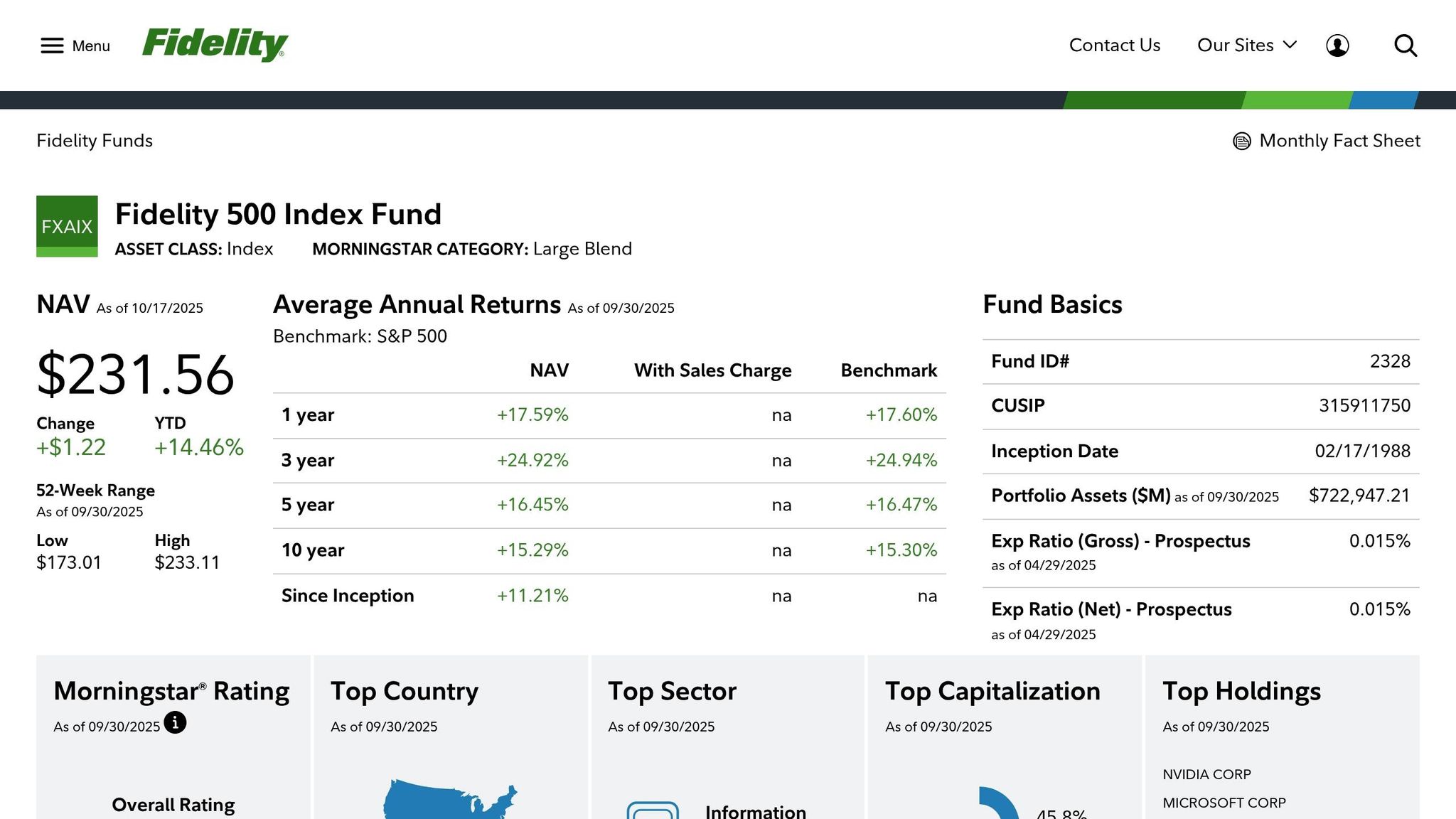
FXAIX: Fidelity 500 Index Fund in a Fidelity Account
Features and Cost Structure
FXAIX is a mutual fund designed to mirror the performance of the S&P 500 index. Since it follows a passive management strategy, the fund typically maintains a low portfolio turnover rate - around 4% annually. This low turnover not only reduces trading activity but also plays a role in managing costs and limiting capital gains within the fund, making it an efficient choice for many investors.
Tax Implications
The fund's low turnover rate contributes to better tax efficiency compared to funds with higher turnover. However, like most mutual funds, any capital gains realized during the year are distributed to shareholders at the end of the year. For investors holding FXAIX in non-retirement accounts, these distributions may be subject to taxes.
Best Fit for Investors
FXAIX appeals to those looking for broad market exposure through a passive investment approach. Its tax-conscious structure is especially appealing to long-term investors who want to keep capital gains distributions to a minimum while benefiting from the overall performance of the S&P 500 index.
VOO: Vanguard S&P 500 ETF in a Fidelity Account
Features and Cost Structure
While FXAIX integrates smoothly within Fidelity's platform, VOO stands out with its flexibility as an ETF. Unlike FXAIX, which operates as a mutual fund, VOO tracks the S&P 500 index and allows intraday trading, much like individual stocks. This means you can trade VOO throughout market hours, giving you more control over timing. With an expense ratio of just 0.03%, it’s one of the most affordable ways to invest in the S&P 500.
However, when buying VOO through Fidelity, you might face commission fees. This is a key difference from FXAIX, which is commission-free. For those making frequent, small-dollar investments, these fees could chip away at your returns.
Another feature of VOO is its real-time pricing, which ensures you know exactly what you're paying or receiving at the moment of trade. It also supports dividend reinvestment, though the process differs from FXAIX. If automatic reinvestment is a priority for you, this distinction is worth keeping in mind.
Tax Efficiency
One of VOO’s biggest advantages is its tax efficiency, thanks to its ETF structure. ETFs, including VOO, use an "in-kind" redemption process, which helps reduce capital gains distributions to shareholders. This makes VOO especially attractive for taxable accounts, where minimizing taxes can significantly impact your overall returns.
Best Fit for Investors
VOO is a great choice for active traders who value intraday pricing and immediate settlement. It’s also a good option for those who frequently transfer assets between different brokerages, as its ETF structure offers portability. However, if you prefer automatic investing or regularly make small purchases, keep an eye on potential commission fees when trading VOO through Fidelity, as these could affect your long-term performance.
FXAIX vs VOO: Costs and Tax Comparison
Comparison Table
Let’s break down the key differences between FXAIX and VOO when held in a Fidelity account. This side-by-side comparison highlights how these funds differ in structure, costs, and flexibility.
| Feature | FXAIX | VOO |
|---|---|---|
| Fund Structure | Mutual Fund | ETF |
| Expense Ratio | 0.015% | 0.03% |
| Trading Fees | Commission-free | May incur commission fees |
| Trading Hours | Once daily after market close | Intraday trading available |
| Minimum Investment | No minimum | One full share (approximately $500) |
| Tax Efficiency | Typical mutual fund distributions | Minimizes capital gains through in-kind redemptions |
| Portability Between Brokers | May incur fees when transferred outside Fidelity | Freely traded across brokers |
FXAIX boasts a lower expense ratio, saving about $1.50 annually per $10,000 invested compared to VOO. While this difference might seem small, it can add up significantly over time, especially in long-term portfolios.
Trading fees are another factor to consider. FXAIX is commission-free, but VOO’s fees can vary depending on your brokerage account type. For frequent traders, these fees might reduce the benefits of VOO's slightly higher expense ratio.
When it comes to taxes, VOO’s ETF structure is generally more tax-efficient, thanks to its ability to minimize capital gains through in-kind redemptions. FXAIX, as a mutual fund, is subject to more traditional distribution rules, which may lead to higher taxable events.
Choosing the Right Option
Your choice between FXAIX and VOO should align with your tax situation, trading habits, and investment goals. Let’s break this down further:
- Taxable Accounts: If you're investing in a taxable account, VOO’s tax efficiency could make it the better choice, especially for those in higher tax brackets. Its structure helps reduce capital gains distributions, potentially offsetting its slightly higher expense ratio.
- Tax-Advantaged Accounts: In accounts like IRAs or 401(k)s, where taxes are less of a concern, FXAIX often wins out. Its lower expense ratio and commission-free trading make it a cost-effective option for long-term investors.
- Investment Amounts: FXAIX allows you to invest exact dollar amounts, making it ideal for those who prefer fractional investing. VOO, on the other hand, requires buying full shares, which can be a hurdle for those with smaller budgets.
- Trading Style: Active traders might gravitate toward VOO because of its intraday trading capability. This feature allows for quicker reactions to market movements and more precise timing for buying or selling shares.
- Portability: If you think you might move your investments to another brokerage in the future, VOO offers more flexibility. It can be traded across different brokers without fees, while FXAIX could incur charges if transferred outside Fidelity.
sbb-itb-e429e5c
FXAIX vs VOO - Side-By-Side Comparison Of Their Differences! (Which One Is Right For You?)
Using Mezzi's Tools for Better Investment Decisions

Choosing between FXAIX and VOO requires careful consideration of costs, taxes, and long-term performance. Mezzi's platform offers a suite of tools to help investors make informed decisions. Here's how Mezzi simplifies tax management, provides real-time insights, and streamlines portfolio oversight.
Tax Optimization and Wash Sales
Managing multiple accounts can increase the risk of wash sales, which can complicate tax reporting. Mezzi helps by monitoring your investments and alerting you to potential wash sale scenarios. For example, if you sell FXAIX in a taxable account but still hold VOO in a tax-advantaged account, Mezzi flags this risk for you.
This proactive approach can help reduce your overall tax liability, especially if you manage a diverse portfolio across various account types.
Real-Time Insights and Analysis
To effectively incorporate FXAIX or VOO into your investment strategy, it's crucial to understand their role within your broader portfolio. Mezzi's X-Ray tool gives you a detailed look at your holdings, uncovering hidden overlaps and potential risks. For instance, if you're holding FXAIX in a Fidelity account while also owning other S&P 500 funds or large-cap stocks elsewhere, the tool consolidates your exposure to companies like Apple or Microsoft. This helps you identify and manage concentration risks.
Additionally, Mezzi's Financial Calculator illustrates how even a small fee difference - like 0.015% - can compound over time. It takes into account your contributions, investment horizon, and tax considerations. AI-driven insights further refine recommendations in real time, adapting to your unique financial situation.
Complete Portfolio Management
One of Mezzi's standout features is its ability to provide a unified view of all your investments. Instead of juggling multiple platforms, you can see your entire financial picture in one place, whether your assets are with Fidelity, Vanguard, or another brokerage. This comprehensive view is particularly valuable when comparing FXAIX and VOO, ensuring you make informed decisions based on your complete portfolio.
Mezzi also offers unlimited AI chat for personalized guidance, answering specific questions like which fund suits your tax bracket or how to optimize your holdings. For more in-depth support, the White Glove Membership includes unlimited AI coaching calls. These sessions provide expert insights for complex decisions, such as Roth conversions or optimizing asset location strategies across taxable and tax-advantaged accounts.
Conclusion
Each fund structure comes with its own set of advantages when it comes to cost and tax considerations. Deciding between FXAIX and VOO boils down to your account type and tax situation - not their performance, as both funds deliver nearly identical returns by tracking the S&P 500.
FXAIX stands out with its lower fees, while VOO's ETF structure significantly reduces taxable events. While the fee difference might seem small, it can add up over time. That said, any fee advantage can quickly be outweighed by the tax implications in taxable accounts.
Tax efficiency is where these funds differ the most. FXAIX, being a mutual fund, may generate capital gains distributions, potentially increasing your tax burden. On the other hand, VOO's ETF structure is designed to minimize these taxable events. In tax-advantaged accounts like IRAs or 401(k)s, where taxes aren’t a concern, FXAIX’s lower expense ratio could give it a slight edge.
"The most important decision is choosing to invest consistently in low-cost index funds rather than trying to beat the market through active management or market timing." - Deltabadger (referencing Jack Bogle)
Ultimately, the choice isn’t just about fees or taxes - it’s about how these factors align with your overall investment strategy. Tools like Mezzi simplify this process by automating the tracking of wash sale risks, capital gains distributions, and portfolio overlaps. With real-time insights, Mezzi helps you optimize your strategy for better after-tax returns, making it easier to align your fund choice with your financial goals.
Whether you’re drawn to FXAIX for its low fees or VOO for its tax efficiency, both are excellent options for building long-term wealth through diversified S&P 500 exposure. The key is to evaluate your specific situation and leverage the right tools to make the most informed decision possible.
FAQs
How do FXAIX and VOO compare in terms of tax efficiency for taxable accounts?
In taxable accounts, the Vanguard S&P 500 ETF (VOO) often stands out as a more tax-friendly option compared to the Fidelity 500 Index Fund (FXAIX). The key lies in VOO's ETF structure, which employs in-kind redemptions. This process allows ETFs to sidestep selling underlying assets during redemptions, significantly reducing capital gains distributions.
On the other hand, mutual funds like FXAIX can trigger more taxable events. This is especially true when they handle large inflows or outflows of investor funds, as such movements may require selling assets. For investors focused on minimizing taxes in their brokerage accounts, VOO tends to be the smarter pick.
How does your trading style affect whether FXAIX or VOO is a better choice in a Fidelity account?
Your trading approach is a crucial factor when choosing between FXAIX and VOO within a Fidelity account. VOO, being an ETF, offers the flexibility to trade throughout the day at market prices. This makes it a strong choice for active investors who want the ability to react to market movements in real time. On the other hand, FXAIX, a mutual fund, trades only at the end-of-day net asset value (NAV). This structure appeals more to long-term investors who appreciate simplicity and the convenience of automatic reinvestment.
If your strategy involves frequent trading or timing the market, VOO might suit your needs better. But if you prefer a more passive, steady wealth-building approach, FXAIX could be the ideal option. Think about your investment goals and trading style to determine which aligns best with your overall strategy.
Why might an investor choose FXAIX over VOO for a tax-advantaged account like an IRA or 401(k)?
When it comes to tax-advantaged accounts like IRAs or 401(k)s, many investors might lean toward FXAIX over VOO. Why? Because in these accounts, tax efficiency takes a backseat, and the focus shifts to keeping costs low. FXAIX generally has a slightly lower expense ratio, making it an appealing choice.
Since tax-advantaged accounts either defer or completely avoid taxes on investment gains, the tax efficiency of an ETF like VOO becomes less of a factor. For long-term investors working with Fidelity accounts, FXAIX offers a cost-effective and straightforward solution.
Related Blog Posts
Table of Contents
Book Free Consultation
Walk through Mezzi with our team, review your current situation, and ask any questions you may have.