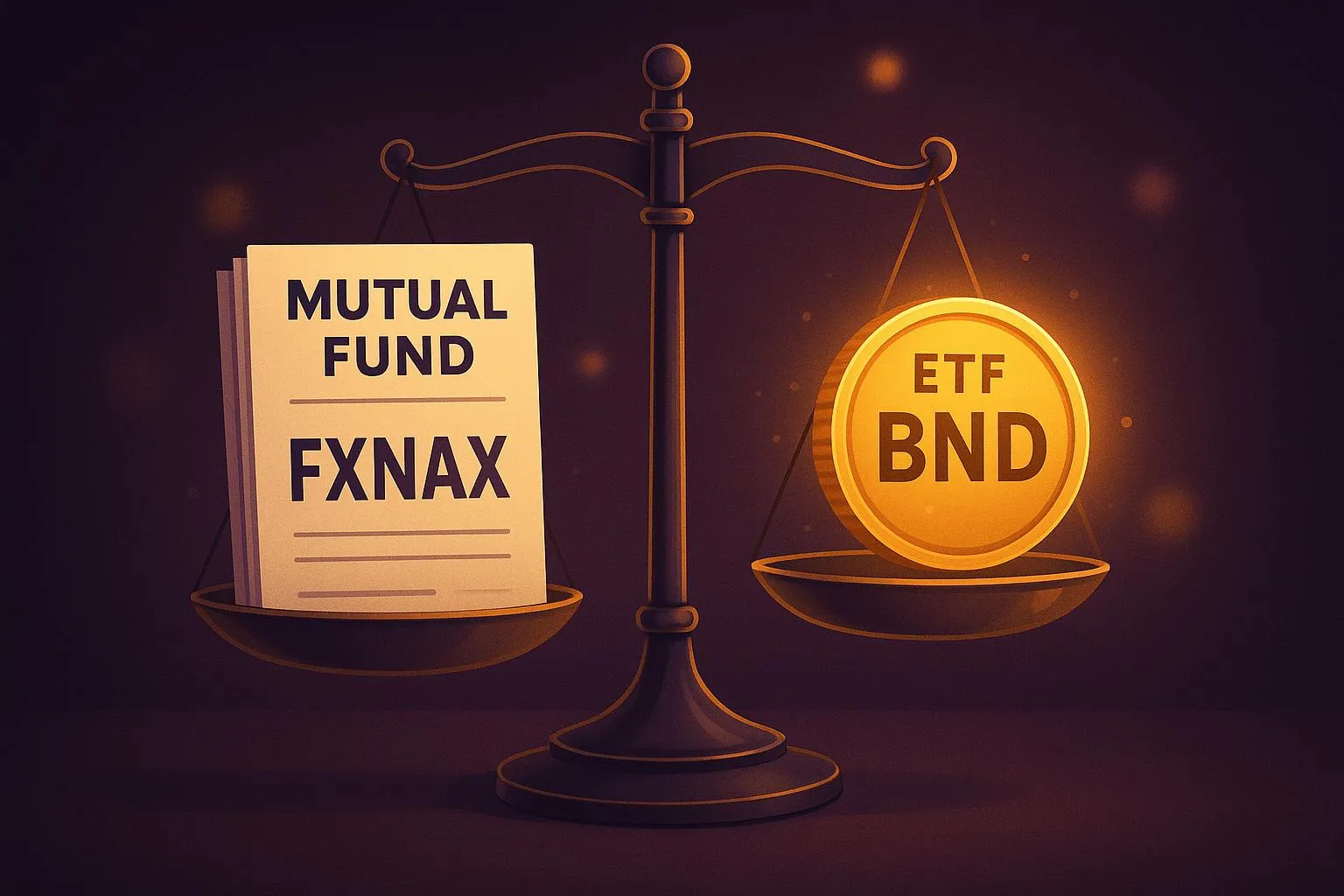
When deciding between FXNAX (Fidelity Total Bond Index Fund) and BND (Vanguard Total Bond Market ETF) on Fidelity's platform, the choice comes down to how you prefer to manage your bond investments. Both funds offer low-cost access to the U.S. bond market, but their structures - mutual fund vs. ETF - carry distinct advantages:
- FXNAX is a mutual fund that supports fractional shares, automatic investing, and trades at its net asset value (NAV) once daily. It's ideal for investors prioritizing simplicity and automation.
- BND is an ETF that trades throughout the day, offering real-time pricing and better tax efficiency. It works well for those who value flexibility and are investing in taxable accounts.
Quick Comparison Table
| Feature | FXNAX (Mutual Fund) | BND (ETF) |
|---|---|---|
| Trading Hours | Once daily at NAV after 4:00 PM ET | Intraday (9:30 AM–4:00 PM ET) |
| Investment Minimum | No minimum, fractional shares allowed | Full shares only |
| Tax Efficiency | Less efficient in taxable accounts | More efficient due to ETF structure |
| Automation | Supports automatic investing | No automatic investing |
| Dividend Reinvestment | Automatic at NAV | May leave small cash balances |
| Best For | Long-term, hands-off investors | Taxable accounts, active traders |
Both funds track similar bond indexes and show nearly identical performance and risk profiles. Your choice should align with your goals: pick FXNAX for ease of use or BND for tax efficiency and trading flexibility.
Is Fidelity's FXNAX The Smarter Treasury Choice?

Fund Basics: FXNAX vs BND
While both funds track broad U.S. bond indexes, they differ in areas like costs, investment thresholds, and how dividends are handled. Let’s break down their cost structures, minimum investment requirements, portfolio composition, and dividend processes to better understand what sets them apart.
Costs and Minimum Investment Requirements
Both FXNAX and BND come with low expense ratios, keeping annual fees minimal. However, their investment requirements differ significantly. FXNAX, available through Fidelity, has no minimum investment requirement. This flexibility makes it an attractive option for investors who want to start small or set up automatic contributions without worrying about thresholds.
BND, in contrast, requires the purchase of whole shares. This means your initial investment must cover at least the price of one full share, which could be a hurdle for those looking to invest smaller amounts right away.
On the bright side, neither fund charges trading commissions when purchased through Fidelity. The brokerage has eliminated commission fees for most ETF and mutual fund transactions, ensuring cost-effective access to both products.
Bond Holdings and Portfolio Structure
Both funds aim to mirror the performance of a broad U.S. bond index. FXNAX tracks the Bloomberg U.S. Aggregate Bond Index, while BND follows a comparable benchmark. As a result, their portfolios include a diversified mix of government bonds, corporate bonds, and mortgage-backed securities.
The two funds also share similar duration and maturity profiles, meaning they respond in comparable ways to changes in interest rates. Their focus on high-quality, investment-grade bonds makes them appealing to conservative investors who prioritize risk management in their fixed-income portfolios.
Dividend Payments and Reinvestment
Both FXNAX and BND distribute monthly dividends, primarily reflecting the interest income generated by their bond holdings. With FXNAX, dividends are automatically reinvested at net asset value (NAV) without any fees, allowing earnings to compound effortlessly over time.
BND also supports automatic dividend reinvestment through Fidelity. However, because BND requires whole-share purchases, there may occasionally be slight delays or small leftover cash balances from dividend reinvestments.
In either case, dividends from both funds are typically taxed as ordinary income, making it important for investors to consider the tax implications of their earnings.
Returns and Risk Analysis
When comparing FXNAX and BND, their performance and risk profiles reveal striking similarities across various market conditions. Both funds follow comparable investment strategies and hold similar types of bonds, resulting in aligned outcomes over time. Let’s break down their historical performance and risk metrics to help guide your choice.
Historical Performance Comparison
Over time, both FXNAX and BND have closely tracked overall bond market trends. Whether during periods of heightened market volatility or shifts in interest rates, their reactions have been nearly identical. Any slight differences in returns typically stem from factors like dividend payout timing or minor tracking discrepancies, rather than fundamental differences in their investment strategies.
Risk Measures and Volatility
In terms of volatility, both funds exhibit the moderate levels typical of the bond market. Key risk metrics, such as standard deviation and the Sharpe ratio (a measure of risk-adjusted returns), show that neither fund consistently assumes more risk than the other. Their similar duration profiles also mean they respond almost identically to changes in interest rates.
Both funds prioritize investment-grade bonds, keeping credit risk low. During challenging market periods, such as rapid interest rate hikes, both have experienced declines of similar severity, followed by comparable recoveries.
Given their nearly identical performance and risk characteristics, the choice between FXNAX and BND is likely to come down to factors like fund structure, trading preferences, or specific investment goals, rather than any notable differences in returns or volatility.
Mutual Fund vs ETF Differences at Fidelity
Understanding how FXNAX and BND differ on Fidelity's platform can influence how you approach your investments. These differences extend beyond performance, shaping how you trade, manage, and interact with your bond investments on a daily basis.
Trading Hours and Pricing
One major distinction lies in the trading schedule and pricing method. FXNAX operates on a once-daily trading model. Orders placed for FXNAX are executed at the fund's net asset value (NAV) after the market closes. This means if you place an order during the day, you'll have to wait until after the 4:00 PM EST cutoff to know the exact price of your purchase.
BND, on the other hand, trades during normal market hours, from 9:30 a.m. ET to 4:00 p.m. ET, Monday through Friday. Additionally, it can be traded during extended hours, including pre-market (4:00 a.m. ET to 9:30 a.m. ET) and after-hours (4:00 p.m. ET to 8:00 p.m. ET). However, trading during these extended periods may come with wider spreads and lower liquidity, making it harder to execute trades at prices that align with the ETF's underlying value. Fidelity typically supports only limit orders for ETFs during extended trading hours, adding another layer of complexity.
These trading differences highlight contrasting approaches to investing, particularly when it comes to automation and reinvestment.
Automatic Investing and Partial Shares
If you prefer a more hands-off approach, FXNAX offers distinct advantages. As a mutual fund, it supports automated investing, making it ideal for strategies like dollar-cost averaging with regular contributions. Another benefit is the ability to invest any dollar amount, including partial shares, ensuring that every penny of your investment is actively put to work.
"Mutual funds are ideal for retirement investing since you can invest any amount. That allows you to invest every last cent and benefit from the market." - Minafi
In contrast, BND requires you to purchase full shares. This means smaller cash balances might sit idle in your account until you accumulate enough to buy another share.
Account Types and Mechanics
Both FXNAX and BND are versatile in terms of account compatibility. You can hold them in retirement accounts like 401(k)s and IRAs, as well as in taxable brokerage accounts. However, their dividend handling differs. FXNAX typically reinvests dividends automatically unless you choose otherwise, while BND dividends are usually deposited as cash, leaving you to decide whether and when to reinvest.
FXNAX's once-daily trading schedule can be a helpful feature for long-term investors, as it reduces the temptation to make impulsive decisions during market fluctuations. On the other hand, BND's continuous trading might encourage reactions to intraday price changes, which could disrupt a disciplined, long-term investment strategy. These operational differences also carry implications for tax efficiency and broader portfolio management.
sbb-itb-e429e5c
Tax Impact and Trading Costs
When investing in taxable accounts, it's crucial to understand how taxes and transaction costs can shape your long-term returns. The structural differences between FXNAX and BND lead to distinct tax profiles, which might influence your investment decisions.
Capital Gains Tax Differences
BND’s ETF structure offers a tax advantage by preventing capital gains distributions through two mechanisms that mutual funds like FXNAX cannot replicate.
First, selling BND shares occurs on an open exchange, which avoids triggering fund-level asset sales. Second, BND benefits from in-kind share redemptions. In situations where there’s an excess supply of BND shares, market makers can redeem them directly with the ETF issuer. Instead of receiving cash, they get the actual underlying bonds, eliminating the need to sell bonds and generate taxable gains.
FXNAX operates differently as a mutual fund. When investors redeem shares, the fund manager often has to sell securities within the portfolio to raise cash for redemptions. Any capital gains from these sales are distributed to all remaining shareholders at year-end, potentially creating a tax liability - even if you didn’t sell your shares.
For example, in 2022, when the S&P 500 returned -18.1%, over 42% of active mutual funds distributed capital gains averaging 5% of their net asset value (NAV). While FXNAX is a passive index fund and less likely to generate significant capital gains compared to active funds, it is still more prone to distributions than BND.
It's also important to note that both funds’ interest payments are subject to ordinary income tax, as discussed in the previous section on dividends.
Beyond taxes, transaction costs also play a role in determining overall investment efficiency.
Trading Fees and Expenses
In addition to tax considerations, FXNAX and BND differ in how trading costs are incurred, reflecting their unique structures. Fidelity offers zero commission for online trades of both FXNAX and BND.
FXNAX trades at its exact NAV at the end of each trading day. This means that when you place an order, you receive the precise value of the fund’s underlying holdings without any additional markup or spread.
BND, as an ETF, involves minor implicit costs. Since it trades on an exchange, it has a bid-ask spread - the gap between what buyers are willing to pay and what sellers are asking. For popular ETFs like BND, this spread is typically narrow but still represents a cost for each trade. Additionally, BND carries a sell-side activity fee, historically ranging from $0.01 to $0.03 per $1,000 of principal. For example, this translates to $0.10 to $0.30 for a $10,000 sale.
While these trading costs are minimal for long-term, buy-and-hold investors, they might matter more for those who trade frequently. However, for investors in higher tax brackets, the tax efficiency of BND - especially its ability to avoid capital gains distributions - often outweighs these minor trading costs. These differences in tax and trading costs highlight the importance of aligning your fund choice with your overall investment strategy.
Which Fund to Choose
The right choice between FXNAX and BND depends largely on your investing style - whether you prioritize automation, tax considerations, or flexibility. As we've already covered the costs, structure, and tax implications, the key now is to align these factors with your personal investment approach. Consider automation, tax efficiency, and your account type to decide which fund aligns best with your financial goals.
Regular Investing and Automation
If simplicity and automation are your priorities, FXNAX is the way to go. It supports automated, fractional-share investing, ensuring every dollar you contribute is put to work immediately. This makes it an excellent fit for investors who want to set up a hands-free, consistent investment strategy.
On the other hand, BND, with its intraday trading feature, isn't as automation-friendly. For those using a dollar-cost averaging approach, FXNAX's straightforward pricing and automation capabilities can make the process much smoother.
Tax Efficiency and Active Management
For taxable accounts, BND's ETF structure has a clear advantage. It minimizes the risk of unexpected capital gains, making it a better choice for investors looking to optimize tax efficiency. Additionally, its intraday trading feature offers greater flexibility for those who prefer active management of their portfolios.
That said, this flexibility does come with minor costs, such as bid-ask spreads and small trading fees. However, these are generally negligible for long-term investors who aren't frequently buying and selling.
Retirement Accounts and Buy-and-Hold Investing
In tax-advantaged accounts, the decision comes down to your investing preferences. FXNAX is ideal for those who value simplicity and automation, while BND appeals to investors who like the option of real-time pricing and greater trading flexibility.
For long-term, buy-and-hold investors, both funds are excellent choices. They each track the Bloomberg U.S. Aggregate Bond Index, have low expense ratios, and provide broad exposure to the U.S. bond market. Ultimately, your decision should reflect your long-term investment objectives and the features that matter most to you.
Final Comparison Summary
Both FXNAX and BND track a broad U.S. bond index, so the right choice depends on your investing preferences. Here’s a quick breakdown to help you decide.
FXNAX is perfect for investors who prioritize automation and fractional-share investing. With its automatic investing features, it’s a great fit for those who value simplicity and steady dollar-cost averaging. You can invest any amount without worrying about share prices or timing your trades.
BND works best for taxable accounts, thanks to its tax-efficient ETF structure and intraday trading. It minimizes unexpected capital gains distributions and allows you to trade during market hours at real-time prices.
For tax-advantaged accounts, where tax efficiency is less critical, the choice boils down to your preference for automation versus control. FXNAX simplifies investing with seamless automation, while BND offers flexibility with intraday trading and precise pricing.
Both funds have nearly identical holdings and charge low expense ratios, ensuring minimal impact on your returns. Performance differences are expected to be negligible.
If automation and fractional investing are your priorities, FXNAX is the way to go. If you need tax efficiency and trading flexibility, BND is the better option. Either way, both funds provide solid core bond exposure for a diversified portfolio. Choose the one that aligns with your investing style and goals to make the most of your bond investments.
FAQs
What are the key tax differences between FXNAX and BND for taxable accounts?
ETFs, such as BND, are generally considered more tax-efficient than mutual funds like FXNAX, thanks to their unique structure and trade-handling process. One key advantage of ETFs is their ability to limit capital gains distributions, which helps reduce the tax impact for investors holding them in taxable accounts.
On the other hand, mutual funds often distribute capital gains more frequently, potentially leading to higher tax obligations for shareholders. For those managing bonds in taxable accounts, this difference in tax treatment can play a crucial role in deciding between these two investment options.
What are the key differences between BND's trading flexibility and FXNAX's automation features, and which is better for long-term investors?
BND (Vanguard Total Bond Market ETF) and FXNAX (Fidelity Total Bond Index Fund) each bring unique benefits tailored to different investing styles. BND, as an ETF, offers flexibility in trading, allowing shares to be bought and sold throughout the trading day at market prices. This feature appeals to investors who prefer to actively manage their portfolios or capitalize on market movements.
In contrast, FXNAX, a mutual fund, emphasizes convenience with automation options like automatic contributions and reinvestments. These features streamline the investing process, making it a great choice for those who favor a hands-off, long-term approach.
For investors focused on simplicity and long-term growth, FXNAX might feel like the better fit. However, if you value the ability to time your trades and maintain control over transactions, BND could align more with your strategy. The decision ultimately hinges on your investment objectives and how involved you want to be in managing your portfolio.
What are the key reasons an investor might choose FXNAX over BND despite their similar performance and risk profiles?
Investors might lean toward FXNAX instead of BND because FXNAX is a mutual fund, and mutual funds come with unique advantages that set them apart from ETFs. For instance, FXNAX enables automated investments, lets you buy fractional shares, and processes trades at the end of the trading day. These features can make managing investments simpler and less stressful for certain individuals.
Another reason to go with FXNAX is the convenience it offers within Fidelity’s platform. Keeping all your investments in one place can make tasks like reviewing account statements, handling taxes, and rebalancing your portfolio much easier to manage.
Related Blog Posts
Table of Contents
Book Free Consultation
Walk through Mezzi with our team, review your current situation, and ask any questions you may have.