
Timing is everything in trading. Entering or exiting a trade at the right moment can mean the difference between growing your portfolio or watching it shrink. Here’s how you can improve your timing and avoid common pitfalls:
- Focus on Entry Points: Buying during a dip instead of at a peak can drastically change your outcome. Even long-term strategies like dollar-cost averaging can benefit from small timing adjustments.
- Master Exit Strategies: Knowing when to sell is just as important - lock in profits when a stock reaches its potential or cut losses before they grow.
- Avoid Emotional Mistakes: Fear and greed lead to bad decisions. Resist the urge to buy during market rallies or sell during panic sell-offs.
- Use AI Tools: Platforms like Mezzi analyze market data in real time, offering actionable insights, spotting trends, and helping you make disciplined, data-driven decisions.
- Combine Indicators: Tools like RSI, MACD, and Bollinger Bands can help predict market movements. Using them together improves timing precision.
- Manage Taxes: Avoid wash sales and optimize tax-loss harvesting to keep more of your gains.
- Control Risk: Adjust position sizes, set stop-loss levels, and monitor market conditions to protect yourself during volatility.
Key Takeaway: Timing isn’t just about luck - it’s about preparation, data, and discipline. With AI-driven tools and a clear strategy, you can make smarter decisions, reduce emotional errors, and improve your trading results.
How I Time Perfect Entries to Avoid Buying Tops And Stop Chasing Price
Using AI Tools for Better Trade Timing
AI platforms are reshaping how investors approach trade timing by simplifying complex market data into clear, actionable insights. Instead of relying on gut instincts, these tools analyze past trends, predict upcoming opportunities, and recommend precise actions, making investment decisions more data-driven and less emotional.
Real-Time Data Analysis
Mezzi’s platform consolidates data from all your investment accounts - whether it’s a 401(k), taxable brokerage account, or IRA - into a single, comprehensive view. This integration uncovers timing opportunities that might go unnoticed when accounts are managed separately. For example, the platform can assist with tax-loss harvesting and help you avoid wash sale violations by instantly identifying overlapping positions across accounts. These real-time insights can save you thousands of dollars in lost tax benefits.
By continuously processing live market data, the platform ensures that decisions are based on up-to-the-minute conditions. Price fluctuations, trading volumes, and shifts in market sentiment are analyzed in real time, enabling the AI to alert you when the timing is right to enter or exit a position. This speed advantage is especially critical during volatile periods when opportunities can disappear in minutes. The AI’s ability to recognize subtle market trends through pattern detection enhances its effectiveness, giving you an edge in fast-moving markets.
AI Pattern Recognition for Market Trends
AI’s ability to identify patterns goes far beyond what human investors typically notice. Mezzi’s algorithms analyze historical price trends, trading volumes, and market cycles to detect recurring patterns that signal optimal timing opportunities. Unlike traditional technical analysis, which often focuses on individual charts, AI evaluates hundreds of indicators across multiple timeframes simultaneously.
These advanced pattern recognition capabilities allow the AI to fine-tune your investment strategies. For example, the system can identify correlations between assets, enabling better timing for portfolio rebalancing. If the AI detects that certain tech stocks tend to underperform during specific market conditions while defensive assets strengthen, it can recommend adjustments before these trends fully unfold.
Seasonal patterns are another area where AI shines. By analyzing recurring behaviors around key events - such as earnings reports, Federal Reserve meetings, or major economic data releases - the AI helps you position your trades to take advantage of predictable market movements. This systematic approach reduces the need to manually track multiple market cycles, freeing up your time while improving precision.
Removing Emotional Bias with AI
One of the most powerful benefits of AI-driven timing tools is their ability to eliminate emotional decision-making. During periods of market volatility, fear and greed often lead investors to make poorly timed trades. AI systems, however, remain entirely objective, basing their recommendations on data rather than reacting to headlines or market sentiment.
By removing human bias, AI promotes a disciplined approach to investing, even during turbulent times. Mezzi’s AI coaching delivers personalized guidance tailored to your strategy, ensuring that every recommendation aligns with your long-term goals. The platform’s real-time AI chat support allows you to address timing concerns as they arise, providing data-backed analysis instead of emotional reassurance. This feature helps build confidence and discipline, reducing the likelihood of impulsive decisions that could derail your financial plans.
AI also excels at identifying when doing nothing is the best move. While human investors often feel pressure to act during market swings, AI can recognize when your current positions are well-suited to the existing conditions and recommend staying put. This helps prevent overtrading, which can erode returns through excessive fees and poorly timed moves. By encouraging patience and precision, AI tools support smarter, steadier wealth-building strategies.
Reading Market Trends and Signals
Grasping market trends and signals is essential for executing trades at the right moment. AI-powered tools excel at processing multiple technical indicators simultaneously, uncovering patterns that guide entry and exit strategies. Here’s how AI interprets these indicators to achieve precise trade timing.
AI Pattern Recognition for Trend Analysis
AI dives deep into technical indicators that reveal momentum changes and potential reversals. Among these, moving averages stand out as reliable tools. A well-known example is the golden cross, which occurs when the 50-day exponential moving average crosses above the 200-day exponential moving average, typically signaling a bullish trend. These averages respond quickly to price shifts.
The Relative Strength Index (RSI), ranging from 0 to 100, is another key metric. A reading above 70 suggests overbought conditions, while below 30 indicates oversold levels. AI can also spot patterns like bullish divergence - when a stock hits a new low, but the RSI forms a higher low - hinting that downward momentum may be easing.
MACD (Moving Average Convergence Divergence) is a momentum indicator that offers buy signals when its line crosses above the signal line and sell signals when it dips below. Additionally, when the MACD histogram starts shrinking toward zero, it often points to a weakening trend.
Bollinger Bands are effective for gauging volatility. Prices touching the upper band suggest overbought conditions, while the lower band signals oversold levels. A "band squeeze", where the bands narrow, often precedes major price movements.
Combining Market Signals with Timing Strategies
While individual indicators provide valuable insights, combining them enhances timing precision. For instance, stochastic oscillators pair well with RSI readings. The stochastic oscillator measures the closing price against its recent range. When both the stochastic oscillator (above 80 or below 20) and the RSI indicate overbought or oversold conditions, it often signals an impending market reversal.
sbb-itb-e429e5c
Improving Entry and Exit Points with Mezzi
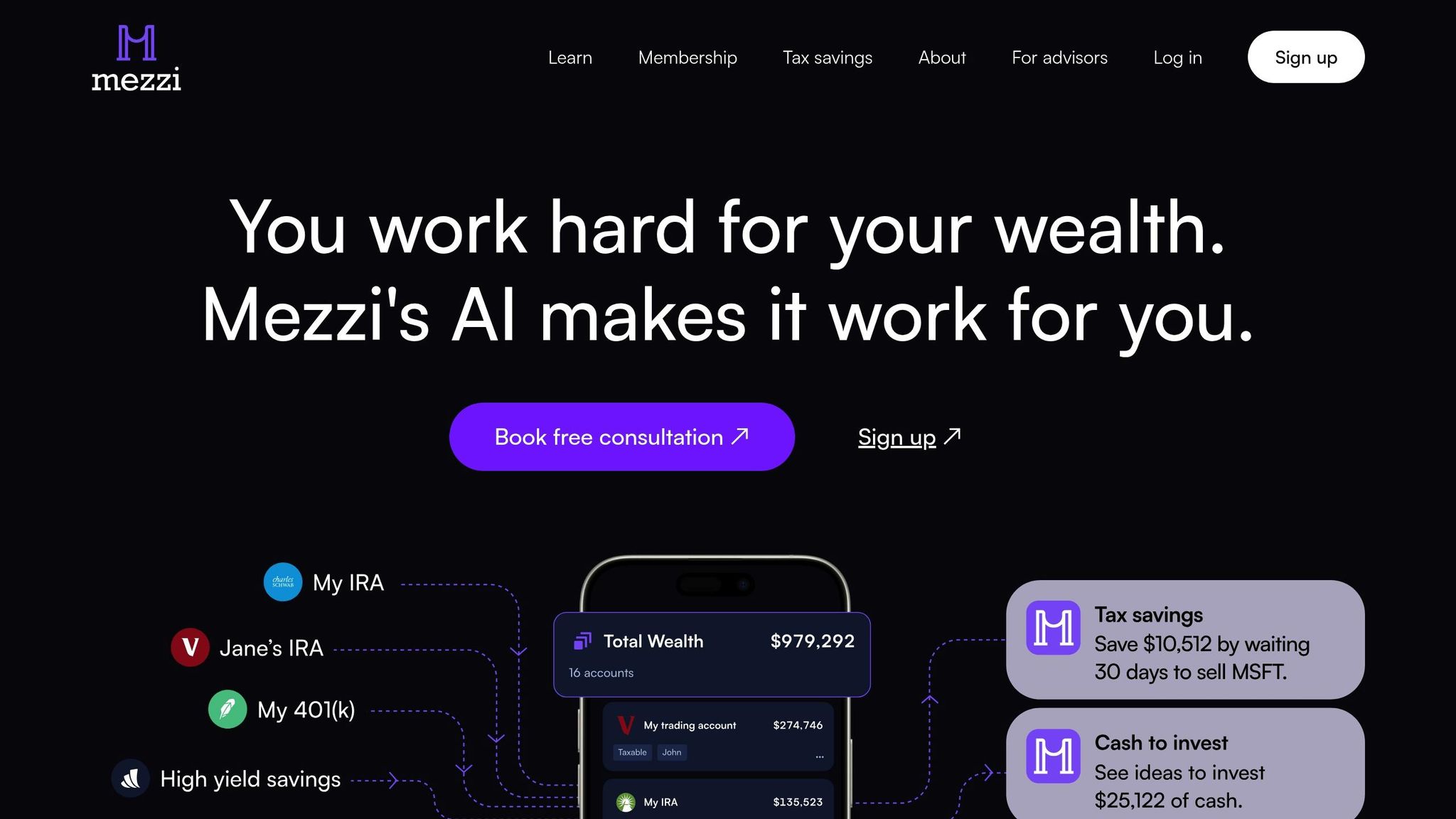
Mezzi turns timing strategies into actionable decisions by leveraging AI. Its tools are designed to help investors fine-tune their entry and exit strategies, all while keeping tax burdens low and aiming for higher returns.
Backtesting Strategies with Historical Data
Mezzi’s backtesting feature lets you test timing strategies against historical market data before putting any real money on the line. It evaluates how your chosen indicators would have performed under various market conditions, helping you identify which combinations deliver the most consistent results.
For instance, you could backtest a golden cross strategy across different market cycles to see how reliable it is. Mezzi processes historical data quickly, pinpointing times when your strategy would have worked or fallen short. This analysis helps you determine if a strategy performs consistently or only shines in certain market environments.
This feature becomes especially useful when testing multiple indicators for exit strategies. Say you’re considering a setup where entry signals require both RSI readings below 30 and MACD crossovers. Mezzi’s historical analysis can show whether this combination improves timing accuracy or simply limits trading opportunities without adding real value. These insights naturally feed into broader portfolio analysis using Mezzi’s specialized tools.
Using the X-Ray Feature for Portfolio Analysis
Building on the insights from backtesting, Mezzi’s X-Ray feature dives deeper into your portfolio to uncover hidden risks that might affect your exit strategies. It’s a powerful tool for identifying exposures you might not even realize exist.
For example, the X-Ray analysis might reveal that your supposedly “diversified” portfolio actually has 40% exposure to technology stocks, even though you thought it was closer to 20%. This level of concentration could significantly impact your exit strategy since a downturn in the tech sector might affect more of your holdings than expected. By understanding these exposures, you can make more informed decisions about when and how to reduce positions, especially before sector-specific volatility strikes.
You could also discover overlapping exposures in your portfolio. For instance, your small-cap value fund and emerging markets fund might hold many of the same underlying stocks. When it’s time to scale back risk, the X-Ray feature helps you decide which positions to exit first, ensuring you adjust your exposure efficiently and effectively.
Tax-Smart Timing Strategies
Mezzi also helps you navigate the complexities of tax-smart timing, avoiding costly errors like wash sales while improving your overall returns. The platform monitors transactions across all connected accounts and flags potential wash sale scenarios before they become an issue.
A wash sale happens when a loss is disallowed because you repurchase a similar security within 30 days. Mezzi’s AI tracks these situations across multiple accounts, optimizing the timing of gains and losses to minimize tax impact. For example, if you’re planning to realize gains in a stock, Mezzi can identify other positions where you might harvest losses to offset those gains. This coordinated approach across your portfolio can save you thousands of dollars in taxes each year.
During volatile markets, Mezzi’s tax-smart timing becomes even more critical. The platform might suggest delaying a sale to steer clear of wash sale rules or advancing loss harvesting before the year ends to maximize tax benefits. These small, calculated timing adjustments can significantly boost your after-tax returns over time. With Mezzi, you’re not just optimizing trades - you’re building stronger overall investment discipline.
Managing Risk During Market Volatility
Market volatility can quickly flip a successful trade into a loss, making it essential to shield your portfolio during unpredictable times. Adapting your timing strategies as conditions shift is key to staying ahead. Mezzi's advanced platform steps in with real-time risk monitoring, helping you keep your exposure under control.
Adjusting Position Size and Allocation
In turbulent markets, sticking to traditional position sizes can amplify risks. Building on earlier insights into real-time analysis, Mezzi's AI suggests adjusting position sizes based on changing market conditions and evolving asset correlations. This ensures your risk profile stays balanced. Thanks to Mezzi’s unified account view, these changes are applied seamlessly across all your accounts. With volatility heightening portfolio risks, fine-tuning position sizes becomes a vital step.
Setting Stop-Loss and Take-Profit Levels
Static stop-loss orders often fall short in fast-moving markets. Mezzi's AI takes a smarter approach by setting dynamic stop-loss and take-profit levels, using both historical and current market data. This tailored strategy helps prevent premature exits while safeguarding against sharp downturns. Plus, the platform factors in wash sale rules to ensure tax-efficient execution of exit strategies. By recommending a tiered method for taking profits, Mezzi allows you to lock in gains gradually without capping your potential upside.
Adapting Strategies in Real Time
Markets can change direction in a heartbeat, rendering old strategies ineffective. Mezzi’s platform constantly monitors your positions alongside broader market trends, providing timely alerts when adjustments are needed. As market conditions evolve, the platform adapts its recommendations, ensuring your strategy aligns with the current environment. In periods of extreme volatility, Mezzi's AI may even suggest pausing certain tactics until clearer signals emerge, keeping your portfolio on the safest path forward.
Conclusion: Trade Timing as a Key to Better Returns
Trade timing can make or break a trade. Entering a position at the right moment can lead to substantial gains, while even a slight delay might result in losses. This guide has highlighted how AI-powered tools are reshaping timing, turning what was once guesswork into a precise, data-driven process.
Traditional methods - like relying on gut feelings or basic technical indicators - leave too much room for error. AI, on the other hand, processes massive amounts of data in real-time, uncovering patterns that humans might miss and removing emotional bias from decision-making. This combination of speed and accuracy can significantly improve trading outcomes.
Mezzi's AI takes timing to the next level by analyzing live data and adapting strategies in real time. Its ability to prevent wash sales across multiple accounts while optimizing entry and exit points showcases how smart automation can handle the finer details that often trip up individual investors.
While market volatility is inevitable, it doesn’t have to be a source of stress. With the right tools and strategies, those price swings can become opportunities. Systems that adjust faster than manual methods are no longer optional - they’re essential.
Key Takeaways for Self-Directed Investors
Here’s how self-directed investors can gain an edge:
- Rely on data, not emotions. AI evaluates historical patterns, market sentiment, and real-time signals all at once. What would take hours of manual research is delivered instantly, minus the emotional pitfalls that lead to poor timing decisions.
- Tax efficiency matters. Even the best timing won’t help if taxes eat away at your gains. Mezzi’s wash sale prevention across multiple accounts can save investors thousands of dollars each year - money that compounds over time. It’s not just about avoiding penalties; it’s about keeping more of what you earn.
- Adaptability beats rigidity. Markets are always changing. Strategies like static stop-losses or fixed position sizes may work for a time, but they’re not foolproof. Dynamic approaches that evolve with market conditions help you stay proactive instead of reacting after losses.
- Risk management supports precision. Strong risk controls allow for more confident timing decisions. Knowing your downside is protected with intelligent stop-losses and position sizing lets you focus on finding the best entry points without fearing catastrophic losses.
The future of investing belongs to those who blend human judgment with AI-driven tools. You don’t need to be a data scientist to succeed, but you do need technology that processes information faster and more accurately than manual analysis ever could. Timing will always be critical in trading - the question is whether you’ll stick to outdated methods or embrace the precision of modern technology.
FAQs
How can AI tools like Mezzi help traders make more objective decisions and avoid emotional mistakes?
AI tools, like Mezzi, empower traders to make more level-headed decisions by processing massive amounts of market data in real time and delivering insights without emotional bias. By following these data-driven recommendations, traders can sidestep emotional pitfalls like fear or greed, which often result in rash or poorly timed trades.
These tools also encourage consistency by providing straightforward strategies for when to enter or exit trades. This guidance helps traders stay committed to their plans, even in turbulent market conditions, reducing the chances of emotional reactions and fostering disciplined, confident decision-making.
What are the best strategies to manage risk during market volatility?
Managing risk during volatile market periods requires a thoughtful and balanced approach. One key strategy is diversifying your investments across various asset classes. By spreading your investments, you reduce the dependency on any single market segment, which can help cushion against sharp declines in specific areas.
Another useful tool is setting stop-loss orders. These allow you to automatically sell assets once they reach a certain price, helping to limit potential losses without requiring constant monitoring.
Equally crucial is maintaining a long-term perspective. Emotional, impulsive decisions during market turbulence can derail your financial goals. Take time to regularly evaluate your risk tolerance and ensure your portfolio reflects your objectives. Staying disciplined and focused during uncertain times can make navigating market shifts more manageable.
How can combining technical indicators improve the timing of trade entries and exits?
Using several technical indicators together can help improve trade timing by offering a more comprehensive view of market conditions. Combining tools like moving averages, RSI (Relative Strength Index), MACD (Moving Average Convergence Divergence), or Fibonacci retracements allows traders to confirm trends, spot momentum changes, and avoid misleading signals.
For instance, pairing a trend-following tool like moving averages with a momentum indicator such as RSI can help determine whether a trend is strong or on the verge of reversing. This strategy minimizes the chances of acting on incomplete information. By integrating multiple indicators, traders can make better-informed decisions about when to enter or exit positions, aiming to boost returns while keeping risks in check.
Related Blog Posts
Table of Contents
Book Free Consultation
Walk through Mezzi with our team, review your current situation, and ask any questions you may have.